Mahleb: Difference between revisions
CSV import |
CSV import |
||
| Line 32: | Line 32: | ||
File:Prma_002_shp_(Prunus_mahaleb).jpg | File:Prma_002_shp_(Prunus_mahaleb).jpg | ||
File:Mahleb_Grinder.jpg | File:Mahleb_Grinder.jpg | ||
</gallery> | |||
<gallery> | |||
File:Prma_002_shp_(Prunus_mahaleb).jpg|Prunus mahaleb | |||
File:Mahleb_Grinder.jpg|Mahleb Grinder | |||
</gallery> | </gallery> | ||
Revision as of 11:26, 25 February 2025
Mahleb or Mahlab is an aromatic spice used in Middle Eastern, Greek and Armenian cuisines. It is made from the seeds of a species of cherry, the St. Lucie Cherry (Prunus mahaleb). The cherry stones are cracked to extract the seed kernel, which is about 5 mm diameter, soft and chewy on extraction. The seed kernel is ground to a powder before use. Its flavor is similar to a combination of bitter almond and cherry, and similarly to almond, it features in pastries and baked goods.
History
The use of Mahleb dates back to the Byzantine Empire, where it was used in breads and pastries. It was later adopted by the Ottoman Empire, and has since spread to various parts of the world, particularly the Middle East and the Mediterranean region.
Culinary Uses
Mahleb is used in small quantities to sharpen sweet foods. It is a common ingredient in holiday foods, especially in pastries. In Greece, it is used in Easter breads (tsoureki), while in the Middle East, it is found in ma'amoul cookies. In Armenia, Mahleb is incorporated into sweet breads and pastries.
Health Benefits
While primarily used as a spice, Mahleb is also known for its health benefits. It is rich in antioxidants and has been used in traditional medicine for its anti-inflammatory and digestive properties.
Production
The largest producer of Mahleb is Turkey, followed by Syria and Iran. The spice is typically harvested in late summer and early autumn.
See Also

.jpg)

-
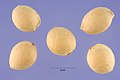 Prunus mahaleb
 -
 Mahleb Grinder
