Pyura chilensis: Difference between revisions
CSV import |
CSV import |
||
| Line 40: | Line 40: | ||
* [https://www.inaturalist.org/taxa/126475-Pyura-chilensis iNaturalist - Pyura chilensis] | * [https://www.inaturalist.org/taxa/126475-Pyura-chilensis iNaturalist - Pyura chilensis] | ||
{{dictionary-stub1}} | {{dictionary-stub1}} | ||
== Pyura_chilensis == | |||
<gallery> | |||
File:Piure_sobre_un_ostion_y_machas.jpg|Piure sobre un ostion y machas | |||
File:DSC07652c.jpg|DSC07652c | |||
File:Piure_Valaparaiso.JPG|Piure Valaparaiso | |||
</gallery> | |||
Latest revision as of 11:24, 25 February 2025
Pyura chilensis[edit]
Pyura chilensis, also known as the "living rock," is a marine creature found off the coast of Chile and Peru. This unique organism is a tunicate, a type of sea squirt, that resembles a rock with a soft, fleshy interior.
Description[edit]
Pyura chilensis is a sessile creature, meaning it is immobile and attached to the ocean floor. It has a rough, rock-like exterior that camouflages it against predators. The interior is soft and red, filled with a blood-like fluid. The creature feeds by filtering sea water through its system and extracting nutrients.
Habitat and Distribution[edit]
Pyura chilensis is found in the intertidal and subtidal zones along the coasts of Chile and Peru. It prefers rocky substrates where it can blend in and avoid predation. The species is particularly abundant in the Antofagasta region of Chile.
Reproduction[edit]
Pyura chilensis is a hermaphrodite, possessing both male and female reproductive organs. It reproduces by releasing eggs and sperm into the water, where fertilization occurs. The resulting larvae are planktonic and drift in the water until they find a suitable substrate to attach to and grow.
Human Use[edit]
In Chile, Pyura chilensis is harvested for food. It is considered a delicacy and is often eaten raw or cooked in various dishes. The creature's unique taste and texture make it a popular choice for seafood lovers.
Conservation Status[edit]
The conservation status of Pyura chilensis is currently unknown. However, overharvesting for food and habitat destruction could potentially threaten the species.
See Also[edit]
References[edit]
- National Geographic - Tunicates
- BBC Earth - The living rock that bleeds
- ScienceDirect - Pyura chilensis: a case study of ecological success
External Links[edit]

Pyura_chilensis[edit]
-
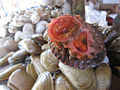 Piure sobre un ostion y machas
 -
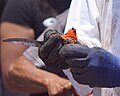 DSC07652c
 -
 Piure Valaparaiso


