Salt March: Difference between revisions
CSV import Tags: mobile edit mobile web edit |
CSV import |
||
| Line 31: | Line 31: | ||
[[Category:1930 in India]] | [[Category:1930 in India]] | ||
{{food-stub}} | {{food-stub}} | ||
== Salt March == | |||
<gallery> | |||
File:Marche_sel.jpg|Marche sel | |||
File:Mahatma_&_Sarojini_Naidu_1930.JPG|Mahatma & Sarojini Naidu 1930 | |||
File:Gandhi_at_Dandi_5_April_1930.jpg|Gandhi at Dandi 5 April 1930 | |||
File:Gandhi_Satyagraha.JPG|Gandhi Satyagraha | |||
File:Badshah_Khan.jpg|Badshah Khan | |||
File:Vedaranyam_salt_march,_April_1930.jpg|Vedaranyam salt march, April 1930 | |||
File:The_attack_of_the_tigress_of_India_on_Dharsana's_salt_factory.jpg|The attack of the tigress of India on Dharsana's salt factory | |||
</gallery> | |||
Revision as of 11:22, 25 February 2025
Salt March
The Salt March, also known as the Dandi March and the Salt Satyagraha, was an act of nonviolent civil disobedience in colonial India led by Mohandas Karamchand Gandhi (Mahatma Gandhi) to produce salt from the seawater in the coastal village of Dandi (now in Gujarat), as was the practice of the local populace until British officials introduced taxation on salt production, deemed their sea-salt reclamation activities illegal, and then repeatedly used force to stop it.
Background
The Salt March was a direct action campaign of tax resistance and nonviolent protest against the British salt monopoly in colonial India, and triggered the wider Civil Disobedience Movement. This was the most significant organised challenge to British authority since the Non-cooperation movement of 1920–22, and directly followed the Purna Swaraj declaration of sovereignty and self-rule by the Indian National Congress on 26 January 1930.
The March
On 12 March 1930, Gandhi set out from his ashram, or religious retreat, at Sabarmati near Ahmedabad with several dozen followers on a trek of some 240 miles to the coastal town of Dandi on the Arabian Sea. There, Gandhi and his supporters were to defy British policy by making salt from seawater. All along the way, Gandhi addressed large crowds, and with each passing day an increasing number of people joined the salt satyagraha. By the time they reached Dandi on 5 April 1930, Gandhi was at the head of a crowd of tens of thousands.
Impact
The Salt March had a significant impact on changing world and British attitudes towards Indian independence and caused large numbers of Indians to join the fight for the first time. After the successful completion of the Dandi March, Mahatma Gandhi was arrested on May 5, 1930, just days before his planned raid on the Dharasana Salt Works. The Dandi March and the ensuing Dharasana Satyagraha drew worldwide attention to the Indian independence movement through widespread newspaper and newsreel coverage.
See also
- Indian independence movement
- Non-cooperation movement
- Civil Disobedience Movement
- Dharasana Satyagraha
- Purna Swaraj
References
<references group="" responsive="1"></references>

Salt March
-
 Marche sel
 -
 Mahatma & Sarojini Naidu 1930
 -
 Gandhi at Dandi 5 April 1930
 -
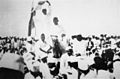 Gandhi Satyagraha
 -
 Badshah Khan
 -
 Vedaranyam salt march, April 1930
 -
The attack of the tigress of India on Dharsana's salt factory


