Gołąbki: Difference between revisions
CSV import |
CSV import |
||
| Line 30: | Line 30: | ||
<gallery> | <gallery> | ||
File:00101_Rindfleisch_-_Kohlroulade,_Podkarpackie.JPG|Gołąbki | File:00101_Rindfleisch_-_Kohlroulade,_Podkarpackie.JPG|Gołąbki | ||
</gallery> | |||
<gallery> | |||
File:00101_Rindfleisch_-_Kohlroulade,_Podkarpackie.JPG|Beef Cabbage Roll, Podkarpackie | |||
</gallery> | </gallery> | ||
Latest revision as of 11:07, 25 February 2025
Go??bki is a traditional Polish dish made from boiled cabbage leaves wrapped around a filling of minced pork or beef, chopped onions, and rice or barley. The name 'go??bki' is plural in Polish, the singular form being 'go??bek'. The word 'go??bki' literally translates to 'little pigeons', reflecting the shape of the dish which resembles small birds.
History[edit]
The origins of go??bki are not definitively known, but it is believed to have been introduced to Poland in the 14th century by Queen Bona Sforza of Italy, who was known for bringing new culinary ideas to Poland. The dish quickly became a staple of Polish cuisine and is now considered a national dish.
Preparation[edit]
The preparation of go??bki begins with the cabbage leaves, which are boiled until they are soft and pliable. The filling is then prepared by sautéing onions in butter until they are translucent, then adding the minced meat and cooking until it is browned. The cooked rice or barley is then mixed in.
The filling is placed on the cabbage leaves, which are then rolled up and secured with a toothpick or string. The rolls are placed in a baking dish, covered with a sauce (usually a tomato-based sauce), and baked in the oven.
Variations[edit]
There are many variations of go??bki throughout Poland and other countries in Eastern Europe. Some versions use different types of meat, such as veal or lamb, while others use different grains, such as buckwheat or millet. Some versions also include additional ingredients in the filling, such as mushrooms or bacon.
Cultural Significance[edit]
Go??bki is often served on special occasions, such as Christmas Eve and Easter, and is a common dish at Polish weddings. It is also a popular dish in other countries with large Polish communities, such as the United States and Canada.
See Also[edit]

-
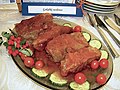 Gołąbki

-
Beef Cabbage Roll, Podkarpackie
