Groundwater pollution: Difference between revisions
From WikiMD's Wellness Encyclopedia
CSV import |
CSV import |
||
| Line 33: | Line 33: | ||
[[Category:Groundwater]] | [[Category:Groundwater]] | ||
{{environment-stub}} | {{environment-stub}} | ||
<gallery> | |||
File:Pit_latrine_and_well_in_close_proximity_(3794846044).jpg|Pit latrine and well in close proximity | |||
File:Groundwater_Contamination_Latin_America_Sm.png|Groundwater Contamination Latin America | |||
File:Shallow_water_well_in_traditional_house_(4359799047).jpg|Shallow water well in traditional house | |||
File:Manure_spreading_-_geograph.org.uk_-_1241415.jpg|Manure spreading | |||
File:Safer_siting_of_sanitation_systems_-_schematic.jpg|Safer siting of sanitation systems - schematic | |||
File:Blaues_Hinweisschild_Wasserschutzgebiet.JPG|Blaues Hinweisschild Wasserschutzgebiet | |||
</gallery> | |||
Latest revision as of 23:59, 24 February 2025
Groundwater pollution refers to the contamination of groundwater bodies, often as a result of human activities. This form of pollution can have serious environmental and health impacts, and is a significant issue worldwide.
Causes of Groundwater Pollution[edit]
Groundwater pollution can be caused by a variety of sources, including:
- Industrial waste: Many industries produce waste products that can contaminate groundwater if not properly disposed of. This includes chemicals, heavy metals, and other toxic substances.
- Agricultural runoff: Fertilizers, pesticides, and animal waste used in agriculture can seep into the ground and contaminate groundwater.
- Landfills: If not properly managed, landfills can leach harmful substances into the ground, contaminating groundwater.
- Sewage and septic systems: Leaks or overflows from sewage systems or septic tanks can contaminate groundwater with harmful bacteria and other pathogens.
- Oil spills and chemical spills: These can contaminate both surface water and groundwater.
Effects of Groundwater Pollution[edit]
Groundwater pollution can have a range of negative effects, including:
- Environmental degradation: Groundwater pollution can harm ecosystems, affecting plant and animal life.
- Human health risks: Contaminated groundwater can pose serious health risks to humans if it is used for drinking, cooking, or irrigation of food crops.
- Economic impact: The cost of cleaning up contaminated groundwater can be significant, and pollution can also affect property values and agricultural productivity.
Prevention and Remediation[edit]
Preventing groundwater pollution involves a range of strategies, including:
- Waste management: Proper disposal of industrial and household waste can help prevent groundwater contamination.
- Regulation and enforcement: Governments can play a key role in preventing groundwater pollution through regulation and enforcement of environmental laws.
- Education and awareness: Educating the public about the importance of groundwater and the risks of pollution can also be an effective prevention strategy.
Remediation of contaminated groundwater can be a complex and costly process. Techniques include pump and treat, bioremediation, and phytoremediation.

This article is a environment-related stub. You can help WikiMD by expanding it!
-
 Pit latrine and well in close proximity
 -
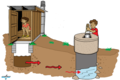 Groundwater Contamination Latin America
 -
 Shallow water well in traditional house
 -
Manure spreading
-
Safer siting of sanitation systems - schematic
-
Blaues Hinweisschild Wasserschutzgebiet
.jpg)

.jpg)


