Hypomyces lactifluorum: Difference between revisions
CSV import |
CSV import |
||
| Line 45: | Line 45: | ||
[[Category:Edible fungi]] | [[Category:Edible fungi]] | ||
[[Category:Fungi of North America]] | [[Category:Fungi of North America]] | ||
== Hypomyces lactifluorum == | |||
<gallery> | |||
File:Hypomyces_lactifluorum.JPG|Hypomyces lactifluorum | |||
File:Hypomyces_lactifluorum_(Lobster_mushroom).jpg|Hypomyces lactifluorum (Lobster mushroom) | |||
</gallery> | |||
Latest revision as of 23:59, 24 February 2025
Hypomyces lactifluorum, commonly known as the Lobster mushroom, is a species of parasitic fungus that colonizes certain types of mushrooms, most notably those in the Russula and Lactarius genera. This fungus is notable for its bright orange-red coloration and its culinary value.
Description[edit]
Hypomyces lactifluorum is a parasitic fungus that transforms its host mushroom into a bright orange-red, crusty mass. The host mushrooms are typically species of Russula or Lactarius. The surface of the infected mushroom becomes rough and hard, and the flesh inside turns white and dense. The transformation is so complete that the original host mushroom is often unrecognizable.
The spores of H. lactifluorum are white, and the fungus itself is classified within the Ascomycota division, which is characterized by the production of spores in sac-like structures called asci.
Habitat and Distribution[edit]
Hypomyces lactifluorum is found in North America, particularly in the eastern United States and Canada. It grows in association with its host mushrooms in deciduous and mixed forests, often appearing in late summer to fall.
Culinary Use[edit]
The Lobster mushroom is highly regarded for its culinary qualities. It has a firm texture and a flavor that is often described as seafood-like, which is where it gets its common name. It is used in a variety of dishes, including soups, stews, and sautés. The bright color of the fungus adds visual appeal to culinary presentations.
Ecological Role[edit]
As a parasitic fungus, Hypomyces lactifluorum plays a role in the ecosystem by interacting with its host mushrooms. While it does not kill the host, it significantly alters its appearance and structure. This interaction is an example of parasitism, where the fungus benefits at the expense of the host.
Also see[edit]
References[edit]
- Arora, David. Mushrooms Demystified: A Comprehensive Guide to the Fleshy Fungi. Ten Speed Press, 1986.
- Lincoff, Gary. The Audubon Society Field Guide to North American Mushrooms. Knopf, 1981.

Hypomyces lactifluorum[edit]
-
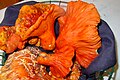 Hypomyces lactifluorum
 -
 Hypomyces lactifluorum (Lobster mushroom)

.jpg)
