Gender disparities in health: Difference between revisions
CSV import |
CSV import |
||
| Line 39: | Line 39: | ||
{{anatomy-stub}} | {{anatomy-stub}} | ||
== Gender disparities in health == | |||
<gallery> | |||
File:Sex_ratio_total_population.PNG|Sex ratio total population | |||
File:FGM_prevalence_UNICEF_2016.svg|FGM prevalence UNICEF 2016 | |||
File:NIH_child_sex_abuse_disorders_graph.svg|NIH child sex abuse disorders graph | |||
File:NIHR-infographic-women-in-healthcare.png|NIHR infographic women in healthcare | |||
File:Training_rural_women_in_Oral_Health_Promotion_activities_in_Nepal.jpg|Training rural women in Oral Health Promotion activities in Nepal | |||
</gallery> | |||
Latest revision as of 23:57, 24 February 2025
Gender disparities in health refer to the differences in health outcomes and indicators between men and women that are avoidable and unjust. These disparities can be influenced by social, economic, and environmental factors, as well as individual behaviors and biological factors.
Overview[edit]
Gender is a significant determinant of health, influencing both the risk of disease and access to health services. Gender disparities in health are not only apparent between men and women, but also among different groups of women and men. These disparities can be attributed to a variety of factors, including socioeconomic status, race, and ethnicity.
Causes[edit]
The causes of gender disparities in health are complex and multifaceted. They include biological differences, social and economic disparities, and health system factors.
Biological differences[edit]
Biological differences between men and women can contribute to disparities in health outcomes. For example, women are more likely to experience certain chronic diseases, such as autoimmune diseases, while men are more likely to experience heart disease and lung cancer.
Social and economic disparities[edit]
Social and economic disparities can also contribute to gender disparities in health. Women, particularly those in low-income communities, often have less access to quality healthcare services. They may also face barriers to healthcare, such as lack of transportation or inability to take time off work.
Health system factors[edit]
Health system factors, such as the availability and quality of healthcare services, can also contribute to gender disparities in health. For example, women may receive less aggressive treatment for heart disease than men, contributing to poorer outcomes.
Impact[edit]
Gender disparities in health can have significant impacts on individuals and communities. They can lead to poorer health outcomes, lower quality of life, and increased healthcare costs. Addressing these disparities is a key priority for public health.
Strategies for addressing gender disparities in health[edit]
There are several strategies for addressing gender disparities in health, including:
- Improving access to healthcare services for women and men
- Addressing social and economic disparities that contribute to health disparities
- Implementing gender-sensitive health policies and programs
- Conducting research to better understand the causes and impacts of gender disparities in health
See also[edit]

Gender disparities in health[edit]
-
 Sex ratio total population
 -
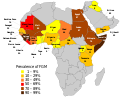 FGM prevalence UNICEF 2016
 -
 NIH child sex abuse disorders graph
 -
 NIHR infographic women in healthcare
 -
 Training rural women in Oral Health Promotion activities in Nepal


