Lateral tarsal artery: Difference between revisions
CSV import |
CSV import |
||
| Line 38: | Line 38: | ||
[[Category:Foot]] | [[Category:Foot]] | ||
{{No image}} | {{No image}} | ||
<gallery> | |||
File:Gray553.png|Gray's Anatomy illustration of the lateral tarsal artery | |||
</gallery> | |||
Revision as of 23:53, 24 February 2025
Lateral Tarsal Artery
The Lateral Tarsal Artery is an important blood vessel located in the foot. It is a branch of the Dorsalis Pedis Artery, which is itself a continuation of the Anterior Tibial Artery. The Lateral Tarsal Artery supplies blood to various structures in the foot, including the lateral side of the tarsal bones and the adjacent soft tissues.
Anatomy
The Lateral Tarsal Artery arises from the Dorsalis Pedis Artery, just below the level of the ankle joint. It runs laterally, or towards the outer side of the foot, along the inferior extensor retinaculum. As it courses along the foot, it gives off several branches that supply blood to different structures.
One of the main branches of the Lateral Tarsal Artery is the Arcuate Artery, which runs in a curved manner around the tarsal bones. This artery provides blood to the lateral side of the tarsal bones and the surrounding soft tissues.
Another important branch is the Dorsal Metatarsal Artery, which supplies blood to the dorsal aspect of the metatarsal bones. This artery further divides into smaller branches that provide blood to the adjacent toes.
Function
The Lateral Tarsal Artery plays a crucial role in maintaining adequate blood supply to the lateral side of the foot. It ensures proper oxygenation and nutrient delivery to the tarsal bones and the surrounding soft tissues, which is essential for their normal functioning.
The blood supplied by the Lateral Tarsal Artery also helps in the removal of waste products and toxins from these structures. This ensures the overall health and well-being of the foot.
Clinical Significance
In certain medical conditions, the Lateral Tarsal Artery may become compromised, leading to reduced blood flow to the lateral side of the foot. This can result in various symptoms, including pain, swelling, and impaired function.
One such condition is Lateral Tarsal Tunnel Syndrome, which is characterized by compression or entrapment of the Lateral Tarsal Artery and its accompanying nerves. This can cause pain, numbness, and tingling sensations along the lateral aspect of the foot.
See Also
References
<references />
-
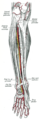 Gray's Anatomy illustration of the lateral tarsal artery

