Long posterior ciliary arteries: Difference between revisions
CSV import |
CSV import Tags: mobile edit mobile web edit |
||
| Line 33: | Line 33: | ||
[[Category:Arteries of the head and neck]] | [[Category:Arteries of the head and neck]] | ||
[[Category:Ophthalmology]] | [[Category:Ophthalmology]] | ||
<gallery> | |||
File:Gray873.png|Gray873 | |||
</gallery> | |||
Latest revision as of 23:52, 24 February 2025
Blood vessel
| General Information | |
|---|---|
| Latin | arteriae ciliares posteriores longae |
| Greek | |
| TA98 | |
| TA2 | |
| FMA | |
| Details | |
| System | |
| Artery | |
| Vein | |
| Nerve | |
| Lymphatic drainage | |
| Precursor | |
| Function | |
| Identifiers | |
| Clinical significance | |
| Notes | |
The long posterior ciliary arteries are two arteries in each eye that play a crucial role in the blood supply to the eye, particularly the choroid, ciliary body, and iris. These arteries are branches of the ophthalmic artery, which itself is a branch of the internal carotid artery.
Anatomy[edit]
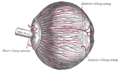
The long posterior ciliary arteries originate from the ophthalmic artery as it travels through the orbit. Each eye typically has two long posterior ciliary arteries, one medial and one lateral. These arteries run forward between the sclera and the choroid, supplying blood to the anterior segment of the eye.
The long posterior ciliary arteries pierce the sclera near the optic nerve and travel forward in the suprachoroidal space. They do not branch significantly until they reach the ciliary body, where they form an arterial circle known as the major arterial circle of the iris. This circle is crucial for supplying blood to the iris and ciliary body.
Function[edit]
The primary function of the long posterior ciliary arteries is to supply oxygenated blood to the anterior segment of the eye, including the ciliary body and iris. This blood supply is essential for the production of aqueous humor by the ciliary processes and for maintaining the health and function of the iris.
Clinical significance[edit]
The long posterior ciliary arteries are important in various clinical conditions. Compromise of these arteries can lead to ischemia of the anterior segment of the eye, potentially resulting in conditions such as anterior ischemic optic neuropathy or uveitis. Understanding the anatomy and function of these arteries is crucial for ophthalmologists and other medical professionals involved in the diagnosis and treatment of eye diseases.
Also see[edit]
Template:Arteries of the head and neck
-
 Gray873

