Ecological footprint: Difference between revisions
CSV import |
|||
| Line 46: | Line 46: | ||
<gallery> | <gallery> | ||
File:Blue_Marble_Western_Hemisphere.jpg|Blue Marble Western Hemisphere | File:Blue_Marble_Western_Hemisphere.jpg|Blue Marble Western Hemisphere | ||
File:Ecological_Footprint_per_person_and_HDI_of_countries_by_world_regions_(2014).jpg|Ecological Footprint per person and HDI of countries by world regions (2014) | File:Ecological_Footprint_per_person_and_HDI_of_countries_by_world_regions_(2014).jpg|Ecological Footprint per person and HDI of countries by world regions (2014) | ||
File:Highlight_Findings_of_the_WA_S0E_2007_report.gif|Highlight Findings of the WA S0E 2007 report | File:Highlight_Findings_of_the_WA_S0E_2007_report.gif|Highlight Findings of the WA S0E 2007 report | ||
</gallery> | </gallery> | ||
Latest revision as of 23:53, 23 February 2025
The ecological footprint is a measure of the impact of human activities, expressed in terms of the area of biologically productive land and water required to produce the goods consumed and to assimilate the wastes generated. It is a critical concept in understanding the sustainability of human activities and their effects on the planet's ecosystems.
Overview[edit]
The ecological footprint is a tool used to quantify the demand placed on Earth's ecosystems by individuals, communities, or nations. It is expressed in global hectares (gha), which represent a standardized unit of biologically productive area with world average productivity. The ecological footprint accounts for the consumption of resources such as food, water, and energy, as well as the absorption of waste, including carbon emissions.
Components of the Ecological Footprint[edit]
The ecological footprint is composed of several key components:
- Carbon Footprint: The amount of land required to absorb carbon dioxide emissions from fossil fuel use.
- Food Footprint: The area needed to grow crops, raise livestock, and support fisheries to provide food.
- Housing Footprint: The space required for buildings and infrastructure.
- Goods and Services Footprint: The land and resources needed to produce consumer goods and services.
- Water Footprint: The volume of freshwater used directly and indirectly by a person or community.
Calculation[edit]
The calculation of the ecological footprint involves assessing the consumption patterns of a population and translating these into the amount of land and water area required to support these activities. This includes:
- Estimating the amount of resources consumed, such as food, energy, and materials.
- Calculating the waste generated, including carbon emissions.
- Converting these figures into the equivalent area of productive land and water.
Significance[edit]
The ecological footprint is significant because it provides a tangible measure of sustainability. It highlights the extent to which human activities exceed the planet's capacity to regenerate resources and absorb waste. A footprint larger than the available biocapacity indicates unsustainable practices, leading to environmental degradation, resource depletion, and loss of biodiversity.
Global Trends[edit]
Globally, the ecological footprint has been increasing, driven by population growth and rising consumption levels. Many countries have footprints that exceed their own biocapacity, relying on imports and the global commons to meet their needs. This overshoot contributes to global challenges such as climate change, deforestation, and pollution.
Reducing the Ecological Footprint[edit]
Efforts to reduce the ecological footprint focus on:
- Improving Energy Efficiency: Reducing energy consumption and transitioning to renewable energy sources.
- Sustainable Agriculture: Promoting practices that increase food production efficiency and reduce environmental impact.
- Waste Reduction: Encouraging recycling, composting, and waste minimization.
- Conservation: Protecting natural habitats and biodiversity.
Related pages[edit]
-
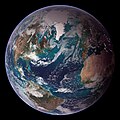 Blue Marble Western Hemisphere
 -
 Ecological Footprint per person and HDI of countries by world regions (2014)
 -
 Highlight Findings of the WA S0E 2007 report

.jpg)

