Cavitation: Difference between revisions
CSV import |
CSV import Tags: mobile edit mobile web edit |
||
| Line 61: | Line 61: | ||
[[Category:Radiology]] | [[Category:Radiology]] | ||
[[Category:Medical signs]] | [[Category:Medical signs]] | ||
== Cavitation == | |||
<gallery> | |||
File:cavitating-prop.jpg|Cavitating Propeller | |||
File:Cavitation.jpg|Cavitation | |||
File:Cavitation_in_a_gear_pump.ogv|Cavitation in a Gear Pump | |||
File:Cavitation_Propeller_Damage.JPG|Cavitation Propeller Damage | |||
File:Turbine_Francis_Worn.JPG|Turbine Francis Worn | |||
File:Cavitation_bubble_implosion.png|Cavitation Bubble Implosion | |||
</gallery> | |||
Latest revision as of 21:44, 23 February 2025
| Cavitation | |
|---|---|
| Synonyms | |
| Pronounce | N/A |
| Specialty | N/A |
| Symptoms | |
| Complications | |
| Onset | |
| Duration | |
| Types | N/A |
| Causes | |
| Risks | |
| Diagnosis | |
| Differential diagnosis | N/A |
| Prevention | N/A |
| Treatment | |
| Medication | N/A |
| Prognosis | |
| Frequency | |
| Deaths | N/A |
Cavitation refers to the formation of cavities or hollow spaces within a solid body or tissue. In the medical field, cavitation can occur in various contexts, including dentistry, pulmonology, and radiology.
Dental Cavitation[edit]
In dentistry, cavitation is often associated with dental caries, commonly known as tooth decay. It involves the demineralization of the tooth enamel and dentin, leading to the formation of cavities.
Pathophysiology[edit]
Dental cavitation begins with the accumulation of dental plaque, a biofilm of bacteria on the tooth surface. The bacteria metabolize sugars from food, producing acids that erode the enamel. If left untreated, the decay progresses to the dentin and can eventually reach the pulp, causing pain and infection.
Diagnosis[edit]
Diagnosis of dental cavitation is typically performed through clinical examination and dental radiography. Dentists look for visible signs of decay and use X-rays to detect cavities that are not visible to the naked eye.
Treatment[edit]
Treatment of dental cavitation involves the removal of decayed tissue and restoration of the tooth structure. This can be achieved through fillings, crowns, or in severe cases, root canal therapy.
Pulmonary Cavitation[edit]
In pulmonology, cavitation refers to the formation of cavities within the lung tissue. This can occur in various lung diseases, including tuberculosis, lung abscess, and certain types of lung cancer.
Causes[edit]
Pulmonary cavitation can result from infectious processes, such as Mycobacterium tuberculosis infection, which leads to the formation of cavitary lesions in the lungs. Other causes include necrotizing pneumonia and fungal infections like aspergillosis.
Diagnosis[edit]
Pulmonary cavitation is diagnosed using imaging techniques such as chest X-ray and computed tomography (CT) scan. These imaging modalities reveal the presence of air-filled spaces within the lung parenchyma.
Treatment[edit]
Treatment depends on the underlying cause of the cavitation. For infectious causes, appropriate antibiotic or antifungal therapy is administered. In some cases, surgical intervention may be necessary to remove necrotic tissue.
Cavitation in Radiology[edit]
In radiology, cavitation is a term used to describe the appearance of hollow spaces within tissues on imaging studies. It is an important radiological sign that can aid in the diagnosis of various conditions.
Imaging Characteristics[edit]
Cavitations appear as radiolucent areas on X-rays and CT scans. The presence of a thick or thin wall surrounding the cavity can provide clues to the underlying pathology. For example, thick-walled cavities are often seen in abscesses, while thin-walled cavities may be indicative of cysts or emphysematous changes.
Clinical Significance[edit]
The identification of cavitation on imaging studies can help differentiate between different types of lung lesions, guide biopsy procedures, and monitor the response to treatment.
Conclusion[edit]
Cavitation is a significant clinical and radiological finding with implications in various medical specialties. Understanding the underlying causes and appropriate management strategies is crucial for effective patient care.
Cavitation[edit]
-
 Cavitating Propeller
 -
 Cavitation
 -
 Cavitation in a Gear Pump
 -
 Cavitation Propeller Damage
 -
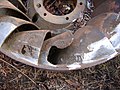 Turbine Francis Worn
 -
 Cavitation Bubble Implosion


