Jellyfish: Difference between revisions
CSV import |
CSV import |
||
| Line 30: | Line 30: | ||
{{stub}} | {{stub}} | ||
{{dictionary-stub1}} | {{dictionary-stub1}} | ||
<gallery> | |||
File:Jelly_cc11.jpg|Jelly cc11 | |||
File:Mastigias_papua_-_Tokyosealifepark_-_2019_1_8.webm|Mastigias papua - Tokyosealifepark - 2019 1 8 | |||
File:Sea_Nettle_Jelly_1.jpg|Sea Nettle Jelly 1 | |||
File:LightRefractsOf_comb-rows_of_ctenophore_Mertensia_ovum.jpg|Light Refracts Of comb-rows of ctenophore Mertensia ovum | |||
File:Cauliflour_Jellyfish,_Cephea_cephea_at_Marsa_Shouna,_Red_Sea,_Egypt_SCUBA.jpg|Cauliflour Jellyfish, Cephea cephea at Marsa Shouna, Red Sea, Egypt SCUBA | |||
File:Thalia_democratica.jpg|Thalia democratica | |||
File:Haliclystus_stejnegeri_1.jpg|Haliclystus stejnegeri 1 | |||
File:Carybdea_marsupialis_screenshot_6.png|Carybdea marsupialis screenshot 6 | |||
File:Phyllorhiza_punctata_macro_II.jpg|Phyllorhiza punctata macro II | |||
File:Nausithoe_aurea.jpg|Nausithoe aurea | |||
File:Hydra-Foto.jpg|Hydra-Foto | |||
File:Portuguese_Man-O-War_(Physalia_physalis).jpg|Portuguese Man-O-War (Physalia physalis) | |||
</gallery> | |||
Latest revision as of 21:44, 23 February 2025
Jellyfish are free-swimming marine animals consisting of a gelatinous umbrella-shaped bell and trailing tentacles. The bell can pulsate for locomotion, while stinging tentacles can be used to capture prey.
Anatomy[edit]
Jellyfish have a complex anatomy. The body of an adult jellyfish consists of a bell-shaped, jellylike substance enclosing its internal structure, from which the creature's tentacles suspend. The jellyfish's mouth is found in the center of its body, which it uses to feed on small fish and plankton, as well as to expel waste.
Life Cycle[edit]
The life cycle of a jellyfish consists of several stages: the fertilized eggs hatch into larvae, which then transform into polyps. These polyps eventually become free-swimming, sexually mature medusae.
Species[edit]
There are many species of jellyfish, each with its unique characteristics. Some of the most well-known include the deadly Box Jellyfish, the large Lion's Mane Jellyfish, and the bioluminescent Comb Jellyfish.
Habitat[edit]
Jellyfish are found in every ocean, from the surface to the deep sea. Some jellyfish live in freshwater. They are particularly common in the warm coastal waters of the Pacific Ocean.
Human Interaction[edit]
Jellyfish have a complicated relationship with humans. They can pose a threat due to their stings, which can be extremely painful and, in some cases, lethal. However, in some cultures, jellyfish are considered a delicacy and are used in traditional medicine.
Conservation[edit]
While some species of jellyfish are abundant, others are threatened or endangered. Overfishing and climate change are among the factors contributing to the decline in jellyfish populations.
See Also[edit]
 | |
|---|---|
 |
 |
| This medical article is a stub. You can help Wikipedia by adding missing information. |
-
 Jelly cc11
 -
 Mastigias papua - Tokyosealifepark - 2019 1 8
 -
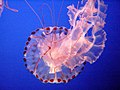 Sea Nettle Jelly 1
 -
 Light Refracts Of comb-rows of ctenophore Mertensia ovum
 -
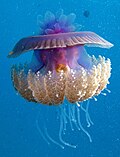 Cauliflour Jellyfish, Cephea cephea at Marsa Shouna, Red Sea, Egypt SCUBA
 -
 Thalia democratica
 -
 Haliclystus stejnegeri 1
 -
 Carybdea marsupialis screenshot 6
 -
 Phyllorhiza punctata macro II
 -
 Nausithoe aurea
 -
 Hydra-Foto
 -
 Portuguese Man-O-War (Physalia physalis)


.jpg)
