Hemozoin: Difference between revisions
CSV import |
CSV import |
||
| Line 27: | Line 27: | ||
[[Category:Malaria]] | [[Category:Malaria]] | ||
[[Category:Biochemistry]] | [[Category:Biochemistry]] | ||
== Hemozoin == | |||
<gallery> | |||
File:Birefringent_P.falciparum_Pigment.jpg|Birefringent P. falciparum Pigment | |||
File:Microphotograph_of_Plasmodium_ovale_microgametocyte_in_Giemsa-stained_thin_blood_film,_with_Schüffner's_dots_and_hemozoin_pigment.png|Microphotograph of Plasmodium ovale microgametocyte in Giemsa-stained thin blood film, with Schüffner's dots and hemozoin pigment | |||
File:P.falciparum_schizont.jpg|P. falciparum schizont | |||
File:Hemozoin_in_food_vacuole.jpg|Hemozoin in food vacuole | |||
File:P.falciparum_hemozoin.jpg|P. falciparum hemozoin | |||
File:Hemozoin_structure.png|Hemozoin structure | |||
File:Hemozoin_crystals.jpg|Hemozoin crystals | |||
File:Drug-heme_interaction.png|Drug-heme interaction | |||
</gallery> | |||
Latest revision as of 21:42, 23 February 2025
Hemozoin is a by-product of the digestion of hemoglobin by certain parasites, including the species of Plasmodium that cause malaria. It is a crystalline substance, dark brown in color, and is often referred to as "malaria pigment."
Formation[edit]
Hemozoin is formed in the food vacuole of the parasite, where hemoglobin is broken down. The process involves the conversion of toxic heme groups into a non-toxic, crystalline form. This is a crucial step in the parasite's lifecycle, as it allows the parasite to survive within the host's red blood cells.
Role in Malaria[edit]
In malaria, the presence of hemozoin is a key indicator of the disease. It is released into the bloodstream when infected red blood cells burst, and can be detected in the blood of infected individuals. The release of hemozoin triggers an immune response in the host, leading to the symptoms of malaria.
Detection[edit]
Hemozoin can be detected in the blood using various methods, including microscopy and rapid diagnostic tests. It is also visible in the stool of infected individuals, providing another method of detection.
Treatment[edit]
The formation of hemozoin is a target for many antimalarial drugs. These drugs work by inhibiting the formation of hemozoin, thereby preventing the parasite from neutralizing the toxic heme groups. This leads to the death of the parasite.
See Also[edit]
References[edit]
<references />
 |
 |
Hemozoin[edit]
-
 Birefringent P. falciparum Pigment
 -
 Microphotograph of Plasmodium ovale microgametocyte in Giemsa-stained thin blood film, with Schüffner's dots and hemozoin pigment
 -
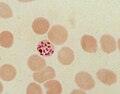 P. falciparum schizont
 -
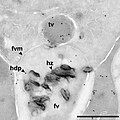 Hemozoin in food vacuole
 -
 P. falciparum hemozoin
 -
 Hemozoin structure
 -
 Hemozoin crystals
 -
Drug-heme interaction


