Wales: Difference between revisions
CSV import |
CSV import Tags: mobile edit mobile web edit |
||
| Line 24: | Line 24: | ||
{{stub}} | {{stub}} | ||
<gallery> | |||
File:Caradog_(5227657).jpg|Caradog | |||
File:Laws_of_Hywel_Dda_(f.1.v)_King_Hywel_cropped.jpg|Laws of Hywel Dda King Hywel | |||
File:George_Childs_Dowlais_Ironworks_1840.jpg|George Childs Dowlais Ironworks 1840 | |||
File:Senedd.JPG|Senedd | |||
File:First_Minister_meeting_with_First_Minister_of_Wales_-_52943408033.jpg|First Minister meeting with First Minister of Wales | |||
File:The_Old_Court_House_Ruthin_Wales.jpg|The Old Court House Ruthin Wales | |||
File:Laws_of_Hywel_Dda_(f.4.r)_Judge_cropped.jpg|Laws of Hywel Dda Judge | |||
File:Yr_Wyddfa_(Snowdon)_from_Crib_Goch,_Parc_Cenedlaethol_Eryri_National_Park,_Cymru_(Wales)_09.jpg|Yr Wyddfa (Snowdon) from Crib Goch, Parc Cenedlaethol Eryri National Park, Cymru (Wales) | |||
File:Map_of_Wales.svg|Map of Wales | |||
File:Milvus_milvus_R(ThKraft).jpg|Milvus milvus | |||
File:Profile_of_Wales.png|Profile of Wales | |||
</gallery> | |||
Latest revision as of 21:39, 23 February 2025
Wales is a country that is part of the United Kingdom and the island of Great Britain. It is bordered by England to the east, the Irish Sea to the north and west, and the Bristol Channel to the south. It had a population in 2011 of 3,063,456 and has a total area of 20,779 km2 (8,023 sq mi). Wales has over 1,680 miles (2,700 km) of coastline and is largely mountainous with its higher peaks in the north and central areas, including Snowdon, its highest summit. The country lies within the north temperate zone and has a changeable, maritime climate.
History[edit]
Wales has been inhabited by modern humans for at least 29,000 years. Continuous human habitation dates from the end of the last ice age, between 12,000 and 10,000 years before present (BP), when Mesolithic hunter-gatherers from central Europe began to migrate to Great Britain. At that time sea levels were much lower than today, and the shallower parts of what is now the North Sea were dry land. The east coast of present day England and the coasts of present day Denmark, Germany and the Netherlands were connected by the former landmass known as Doggerland, forming the British Peninsula on the European mainland. The post-glacial rise in sea level separated Wales and Ireland, forming the Irish Sea. Doggerland was submerged by the North Sea and, by 8000 BP, the British Peninsula had become an island. By the beginning of the Neolithic (around 6000 BP), sea levels in the Bristol Channel were still about 33 feet (10 metres) lower than today.
Geography[edit]
Wales is located on the western side of central southern Great Britain. To the north and west is the Irish Sea, and to the south is the Bristol Channel. The English counties of Cheshire, Shropshire, Herefordshire and Gloucestershire lie to the east.
Culture[edit]
The culture of Wales is based on the traditions of the Celtic people who once inhabited the region, but it has been influenced by the English and other European cultures. The Welsh language is a key part of the culture, and many people in Wales are bilingual, speaking both Welsh and English.
Economy[edit]
The economy of Wales is diverse and includes sectors such as agriculture, manufacturing, and services. The service sector is the largest part of the Welsh economy, contributing over 66% of the country's GDP.
See also[edit]
 | |
|---|---|
 |
 |
-
 Caradog
 -
 Laws of Hywel Dda King Hywel
 -
 George Childs Dowlais Ironworks 1840
 -
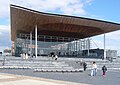 Senedd
 -
 First Minister meeting with First Minister of Wales
 -
 The Old Court House Ruthin Wales
 -
 Laws of Hywel Dda Judge
 -
 Yr Wyddfa (Snowdon) from Crib Goch, Parc Cenedlaethol Eryri National Park, Cymru (Wales)
 -
 Map of Wales
 -
 Milvus milvus
 -
 Profile of Wales
.jpg)
_King_Hywel_cropped.jpg)


_Judge_cropped.jpg)
_from_Crib_Goch,_Parc_Cenedlaethol_Eryri_National_Park,_Cymru_(Wales)_09.jpg)

.jpg)

