Hadrosaur diet: Difference between revisions
CSV import Tags: Replaced mobile edit mobile web edit |
CSV import |
||
| Line 22: | Line 22: | ||
[[Category:Paleontology]] | [[Category:Paleontology]] | ||
{{medicine-stub}} | {{medicine-stub}} | ||
== Hadrosaur_diet == | |||
<gallery> | |||
File:Parasaurolophus_cyrtocristatus.jpg|Parasaurolophus cyrtocristatus | |||
File:Knight_hadrosaurs.jpg|Knight hadrosaurs | |||
File:Edmontosaurusskel.jpg|Edmontosaurus skeleton | |||
File:Equisetopsida.jpg|Equisetopsida | |||
</gallery> | |||
Latest revision as of 21:39, 23 February 2025
Hadrosaur Diet[edit]
Hadrosaurs, also known as duck-billed dinosaurs, were herbivorous dinosaurs that lived during the Late Cretaceous period. These dinosaurs were characterized by their unique dental structure, which was adapted for grinding plant material. The diet of hadrosaurs consisted primarily of vegetation such as ferns, cycads, and conifers.
Dental Adaptations[edit]
Hadrosaurs had specialized dental adaptations that allowed them to efficiently process plant material. Their teeth were arranged in dental batteries, with multiple rows of teeth in the upper and lower jaws. These teeth were tightly packed together and had a flattened shape, ideal for grinding tough plant material. The dental batteries in hadrosaurs were continuously replaced throughout their lives, ensuring that they always had functional teeth for feeding.
Feeding Behavior[edit]
Hadrosaurs were well-adapted for feeding on a variety of plant types. They likely used their broad, duck-like bills to crop vegetation close to the ground. Their powerful jaws and grinding teeth enabled them to process tough plant material, extracting nutrients from fibrous plants. Some hadrosaurs may have also fed on aquatic plants, using their specialized dentition to filter out water and extract plant matter.
Gut Morphology[edit]
The digestive systems of hadrosaurs were adapted to process large amounts of plant material. They had long, complex intestines that allowed for efficient digestion of fibrous plant matter. Some hadrosaurs may have also had specialized fermentation chambers in their digestive tracts, similar to those found in modern herbivores, to aid in the breakdown of cellulose.
Conclusion[edit]
In conclusion, hadrosaurs were herbivorous dinosaurs with specialized adaptations for feeding on plant material. Their unique dental structure, feeding behavior, and digestive morphology all point to a diet consisting primarily of vegetation. By studying the diet of hadrosaurs, paleontologists can gain valuable insights into the ecology and behavior of these fascinating dinosaurs.

Hadrosaur_diet[edit]
-
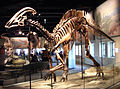 Parasaurolophus cyrtocristatus
 -
 Knight hadrosaurs
 -
 Edmontosaurus skeleton
 -
 Equisetopsida


