Big Bang: Difference between revisions
CSV import |
CSV import |
||
| Line 28: | Line 28: | ||
{{Big Bang}} | {{Big Bang}} | ||
{{Astronomy-stub}} | {{Astronomy-stub}} | ||
== Big Bang == | |||
<gallery> | |||
File:CMB_Timeline300_no_WMAP.jpg|CMB Timeline | |||
File:2MASS_LSS_chart-NEW_Nasa.jpg|2MASS LSS Chart | |||
File:Heic1401a-Abell2744-20140107.jpg|Abell 2744 | |||
File:XDF-scale.jpg|XDF Scale | |||
File:The_Hubble_eXtreme_Deep_Field.jpg|The Hubble eXtreme Deep Field | |||
File:XDF-separated.jpg|XDF Separated | |||
File:Redshifted.png|Redshifted | |||
File:Cmbr.svg|CMBR | |||
File:WMAP_2012.png|WMAP 2012 | |||
File:Universe-09-00183-g004.png|Universe Diagram | |||
File:PIA17993-DetectorsForInfantUniverseStudies-20140317.jpg|Detectors for Infant Universe Studies | |||
File:Cosmological_Composition_–_Pie_Chart.svg|Cosmological Composition Pie Chart | |||
</gallery> | |||
Latest revision as of 21:38, 23 February 2025
The Big Bang is the prevailing cosmological model explaining the origin of the Universe from the earliest known periods through its subsequent large-scale evolution. The model describes how the Universe expanded from a very high-density and high-temperature state, and offers a comprehensive explanation for a broad range of phenomena, including the abundance of light elements, the Cosmic Microwave Background (CMB), and large-scale structure.
Overview[edit]
The term "Big Bang" was originally coined by Fred Hoyle during a 1949 radio broadcast, intended as a pejorative to describe the theory which posits that the Universe began as a small singularity, then inflated over the next 13.8 billion years to the cosmos that we know today. Despite its initial reception, the Big Bang theory has become the most widely accepted and supported explanation among the scientific community for the origin of the Universe.
Evidence[edit]
Several lines of evidence support the Big Bang theory. The most compelling include the observation of the redshift of galaxies, indicating that the Universe is expanding; the discovery of the Cosmic Microwave Background radiation, a relic of the early Universe; and the distribution of light elements, such as hydrogen and helium, which matches predictions from the Big Bang nucleosynthesis models.
Cosmic Microwave Background[edit]
The Cosmic Microwave Background is considered the afterglow radiation from the Big Bang, discovered in 1965 by Arno Penzias and Robert Wilson. This discovery provided substantial evidence that the Universe had a hot and dense origin.
Galactic Redshift[edit]
Observations by Edwin Hubble in 1929 showed that galaxies are moving away from us in all directions, a phenomenon known as the Hubble expansion. This observation is a cornerstone of the Big Bang theory, indicating that the Universe itself is expanding.
Big Bang Nucleosynthesis[edit]
Big Bang nucleosynthesis refers to the production of light elements in the early stages of the Universe. The relative abundances of light elements such as hydrogen, helium, and lithium observed in the Universe match the predictions made by Big Bang nucleosynthesis models, providing strong evidence for the theory.
Theoretical Framework[edit]
The Big Bang theory is grounded in the equations of general relativity, with modifications that account for quantum mechanics at the singularity. The theory has evolved over time, incorporating new observations and measurements. One of the significant developments is the concept of inflation, a period of exponential expansion that is believed to have occurred in the first fractions of a second after the Big Bang.
Challenges and Future Directions[edit]
While the Big Bang theory is the most widely accepted model for the Universe's origin and evolution, it is not without its challenges. These include the horizon problem, the flatness problem, and the mystery of dark matter and Dark Energy. The theory of inflation was proposed to address some of these issues, but it also requires further empirical validation.
Ongoing and future observations, such as those from the James Webb Space Telescope and other advanced telescopes, promise to provide deeper insights into the early Universe, potentially offering more evidence in support of the Big Bang theory or leading to new theories altogether.

Big Bang[edit]
-
 CMB Timeline
 -
 2MASS LSS Chart
 -
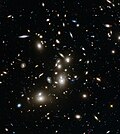 Abell 2744
 -
 XDF Scale
 -
 The Hubble eXtreme Deep Field
 -
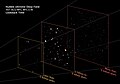 XDF Separated
 -
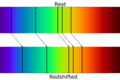 Redshifted
 -
 CMBR
CMBR -
 WMAP 2012
 -
 Universe Diagram
 -
 Detectors for Infant Universe Studies
 -
 Cosmological Composition Pie Chart


