Cotton: Difference between revisions
CSV import |
CSV import Tags: mobile edit mobile web edit |
||
| Line 34: | Line 34: | ||
{{stub}} | {{stub}} | ||
<gallery> | |||
File:BALLS_OF_COTTON_(ANDHRA_-SOUTH_INDIA)_READY_FOR_HARVEST.jpg|Balls of cotton ready for harvest | |||
File:Mehrgarh_pakistan_rel96.JPG|Mehrgarh Pakistan | |||
File:Mandeville_cotton.jpg|Mandeville cotton | |||
File:Vegetable_lamb_(Lee,_1887).jpg|Vegetable lamb | |||
File:Renaldis_muslin_woman.jpg|Renaldis muslin woman | |||
File:Cotton_Picking_in_Egypt.tif|Cotton picking in Egypt | |||
File:Cotton_bales_at_the_port_in_Bombay_in_the_1860s.JPG|Cotton bales at the port in Bombay in the 1860s | |||
File:William_L._Sheppard_-_First_use_of_the_Cotton_Gin,_Harper's_weekly,_18_Dec._1869,_p._813.png|First use of the Cotton Gin | |||
File:MapCotton-1907-2023.jpg|Map of cotton 1907-2023 | |||
File:Espanya_Industrial_-_segle_XIX.jpg|Espanya Industrial - segle XIX | |||
File:Cotton_pickers_and_overseer_around_1850.jpg|Cotton pickers and overseer around 1850 | |||
File:Family_of_slaves_in_Georgia,_circa_1850.jpg|Family of slaves in Georgia, circa 1850 | |||
</gallery> | |||
Latest revision as of 21:37, 23 February 2025
Cotton is a soft, fluffy staple fiber that grows in a boll, or protective case, around the seeds of the cotton plants of the genus Gossypium in the mallow family Malvaceae. The fiber is almost pure cellulose. Under natural conditions, the cotton bolls will increase the dispersal of the seeds.
History[edit]
The plant is a shrub native to tropical and subtropical regions around the world, including the Americas, Africa, Egypt and India. The greatest diversity of wild cotton species is found in Mexico, followed by Australia and Africa. Cotton was independently domesticated in the Old and New Worlds.
Uses[edit]
The fiber is most often spun into yarn or thread and used to make a soft, breathable textile. The use of cotton for fabric is known to date to prehistoric times; fragments of cotton fabric dated to the fifth millennium BC have been found in the Indus Valley Civilization, as well as fabric remnants dated back to 6000 BC in Peru.
Production[edit]
Cotton is a valuable crop because it is a mainstay of many economies, especially in developing areas. It requires a lot of water to grow and process, and it is often grown with large amounts of pesticides. Cotton production is very labor-intensive, but mechanization and genetic engineering have reduced the cost.
Health implications[edit]
Cotton can be a source of allergens, especially in occupational settings. Cotton dust can cause byssinosis, a lung disease. Cottonseed oil is used in some margarines, salad dressings, cosmetics, soap, candles, water proofing agents and other products.
See also[edit]
- Cotton gin
- Cottonseed oil
- Cotton production
- Cotton-spinning machinery
- Cotton-picking
- Cotton processing
References[edit]
<references />
External links[edit]
 | |
|---|---|
 |
 |
-
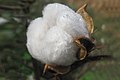 Balls of cotton ready for harvest
 -
 Mehrgarh Pakistan
 -
 Mandeville cotton
 -
 Vegetable lamb
 -
 Renaldis muslin woman
 -
 Cotton picking in Egypt
 -
 Cotton bales at the port in Bombay in the 1860s
 -
 First use of the Cotton Gin
 -
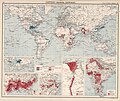 Map of cotton 1907-2023
 -
 Espanya Industrial - segle XIX
 -
 Cotton pickers and overseer around 1850
 -
 Family of slaves in Georgia, circa 1850
_READY_FOR_HARVEST.jpg)


.jpg)


