Fish anatomy: Difference between revisions
CSV import Tags: mobile edit mobile web edit |
CSV import Tags: mobile edit mobile web edit |
||
| Line 25: | Line 25: | ||
[[Category:Fish]] | [[Category:Fish]] | ||
{{stub}} | {{stub}} | ||
== Fish_anatomy == | |||
<gallery> | |||
File:Lampanyctodes_hectoris_(Hector's_lanternfish).svg|Hector's lanternfish | |||
File:Internal_organs_of_a_fish.svg|Internal organs of a fish | |||
File:Anatomical_Directions_and_Axes.JPG|Anatomical Directions and Axes | |||
File:Lingcodskeleton1600ppx.JPG|Lingcod skeleton | |||
File:Skeleton_of_a_bass.jpg|Skeleton of a bass | |||
File:Szkielet_dorsza.jpg|Cod skeleton | |||
File:Pristella_maxillaris.jpg|Pristella maxillaris | |||
File:Vertebre_pesce_20130806_04.jpg|Fish vertebrae | |||
File:Seahose_(Hippocampus)_skull_labeled.png|Seahorse skull labeled | |||
File:PyskiRyb.svg|Fish mouths | |||
File:BARBEL_(PSF).png|Barbel | |||
File:Esox_luciusZZ.jpg|Northern pike | |||
</gallery> | |||
Latest revision as of 21:36, 23 February 2025
Fish anatomy is the study of the form or morphology of fishes. It can be contrasted with fish physiology, which is the study of how the component parts of fish function together in the living fish. In practice, fish anatomy and fish physiology complement each other, the former dealing with the structure of a fish, its organs or component parts and how they are put together, such as might be observed on the dissecting table or under the microscope, and the latter dealing with how those components function together in the living fish.
External anatomy[edit]
The anatomy of fish is often shaped by the physical characteristics of water, the medium in which fish live. Water is much denser than air, holds a relatively small amount of dissolved oxygen, and absorbs more light than air does.
Body shape[edit]
The body of a fish is divided into a head, trunk and tail, although the divisions between the three are not always externally visible. The skeleton, which forms the support structure inside the fish, is either made of cartilage, in cartilaginous fish, or bone in bony fish. The main skeletal element is the vertebral column, composed of articulating vertebrae which are lightweight yet strong. The ribs attach to the spine and there are no limbs or limb girdles. The main external features of the fish, the fins, are composed of either bony or soft spines called rays which, with the exception of the caudal fins, have no direct connection with the spine. They are supported by the muscles which compose the main part of the body. The heart has two chambers and pumps the blood through the respiratory surfaces of the gills and on round the body in a single circulatory loop.
Internal anatomy[edit]
The internal organs can be loosely divided into three sections: the head holds the brain, sensory organs, and the forward end of the digestive system; the trunk holds the heart, liver, gonads and most of the digestive system; and the tail holds the anus and the posterior part of the digestive system.
Digestive system[edit]
The digestive system of fish typically includes a mouth, pharynx, esophagus, stomach, intestine, and anus. The mouth is surrounded by the jaws and contains the teeth. The pharynx is a part of the conducting zone of the respiratory system and also a part of the digestive system. It is essentially a pathway to the lungs and stomach. The esophagus is a part of the conducting zone of the respiratory system and also a part of the digestive system. It is essentially a pathway to the lungs and stomach.
Respiratory system[edit]
Fish exchange gases by pulling oxygen-rich water through their mouths and pumping it over their gills. In some species, the respiratory system also allows them to breathe air, but most fish exchange gases like oxygen and carbon dioxide using gills that are protected under gill covers on both sides of the pharyngeal region.
See also[edit]
 | |
|---|---|
 |
 |
Fish_anatomy[edit]
-
 Hector's lanternfish
 -
 Internal organs of a fish
 -
 Anatomical Directions and Axes
 -
 Lingcod skeleton
 -
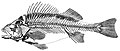 Skeleton of a bass
 -
 Cod skeleton
 -
 Pristella maxillaris
 -
 Fish vertebrae
 -
 Seahorse skull labeled
 -
 Fish mouths
 -
 Barbel
 -
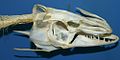 Northern pike
.svg)


_skull_labeled.png)

.png)

