Retirement: Difference between revisions
CSV import Tag: Replaced |
CSV import |
||
| Line 33: | Line 33: | ||
{{stub}} | {{stub}} | ||
== Retirement == | |||
<gallery> | |||
File:20200101_Life_expectancy_increases_with_age_already_achieved_-_chart.svg|Life expectancy increases with age already achieved - chart | |||
File:20230331_Average_retirement_savings_account_balances_and_median_net_worth,_by_age,_US.svg|Average retirement savings account balances and median net worth, by age, US | |||
File:Work_40_retire_20.jpg|Work 40 retire 20 | |||
File:Year-to-year_portfolio_balances_example_73-75.gif|Year-to-year portfolio balances example 73-75 | |||
File:20200101_Remaining_life_expectancy_-_US.svg|Remaining life expectancy - US | |||
</gallery> | |||
Latest revision as of 21:35, 23 February 2025
Retirement is a stage in life where an individual stops employment completely. The decision to retire is multifaceted and depends on various factors such as the individual's financial status, health condition, and personal preferences. Retirement is often associated with the end of one's working life and the beginning of a new phase that involves leisure, travel, and other personal pursuits.
Definition[edit]
Retirement is defined as the withdrawal from one's occupation, or from active working life. The traditional age for retirement in many countries is 65, although this varies depending on the country and the individual's personal circumstances.
Factors influencing retirement[edit]
Several factors influence the decision to retire. These include:
- Financial status: The individual's financial situation plays a crucial role in the decision to retire. Those with sufficient savings and investments are more likely to retire early.
- Health condition: Health issues can force individuals to retire earlier than planned. On the other hand, good health can enable individuals to work beyond the traditional retirement age.
- Personal preferences: Some individuals may choose to retire early to pursue hobbies, travel, or spend more time with family.
Retirement planning[edit]
Retirement planning involves determining retirement income goals and the actions necessary to achieve these goals. Retirement planning includes identifying sources of income, estimating expenses, implementing a savings program, and managing assets and risk.
Retirement systems[edit]
Different countries have different systems for retirement. These can be broadly classified into:
- Public pensions: These are government-provided pensions that are funded by taxes.
- Occupational pensions: These are pensions provided by employers.
- Personal pensions: These are pensions that individuals contribute to independently.
See also[edit]
 | |
|---|---|
 |
 |
Retirement[edit]
-
 Life expectancy increases with age already achieved - chart
 -
 Average retirement savings account balances and median net worth, by age, US
 -
 Work 40 retire 20
 -
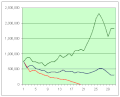 Year-to-year portfolio balances example 73-75
 -
 Remaining life expectancy - US


