Rayleigh scattering: Difference between revisions
CSV import Tags: mobile edit mobile web edit |
CSV import |
||
| Line 32: | Line 32: | ||
[[Category:Atmospheric physics]] | [[Category:Atmospheric physics]] | ||
[[Category:Scattering, absorption and radiative transfer (optics)]] | [[Category:Scattering, absorption and radiative transfer (optics)]] | ||
<gallery> | |||
File:Leehasacamera_-_Sunset_over_the_clouds_(by).jpg|Sunset over the clouds | |||
File:Monochrome_Rainbow.jpg|Monochrome Rainbow | |||
File:Rayleigh_sunlight_scattering.svg|Rayleigh sunlight scattering | |||
File:CircularPolarizer.jpg|Circular Polarizer | |||
File:Why_is_the_sky_blue.jpg|Why is the sky blue | |||
</gallery> | |||
Latest revision as of 21:34, 23 February 2025
Rayleigh scattering refers to the scattering of light or other electromagnetic radiation by particles much smaller than the wavelength of the radiation. Named after the British scientist Lord Rayleigh, it is an important principle in the fields of optics and atmospheric physics.
Overview[edit]
Rayleigh scattering is a function of the fourth power of the wavelength, so shorter wavelength light is scattered more than longer wavelength light. This phenomenon is responsible for the blue color of the sky during the day and the reddening of the sun at sunset.
Mathematical description[edit]
The intensity of Rayleigh scattering is given by the Rayleigh scattering cross section, which is derived from the Mie theory. The formula for the Rayleigh scattering cross section is:
σ = (8π/3) * (d/λ)^4 * (n^2 - 1)^2 / (n^2 + 2)^2
where d is the diameter of the particle, λ is the wavelength of light, and n is the refractive index of the particle.
Applications[edit]
Rayleigh scattering has many practical applications. It is used in meteorology to explain the color of the sky and in optical fiber communication to limit the transmission distance. It is also used in spectroscopy to study the properties of materials.
See also[edit]
References[edit]
<references />
 | This physics-related article is a stub. You can help Wikipedia by adding missing information. |
-
 Sunset over the clouds
 -
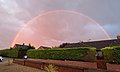 Monochrome Rainbow
 -
 Rayleigh sunlight scattering
 -
 Circular Polarizer
 -
 Why is the sky blue
.jpg)


