Pyroclastic flow: Difference between revisions
CSV import Tags: mobile edit mobile web edit |
CSV import Tags: mobile edit mobile web edit |
||
| Line 27: | Line 27: | ||
{{Volcanoes-stub}} | {{Volcanoes-stub}} | ||
{{Geology-stub}} | {{Geology-stub}} | ||
== Pyroclastic_flow == | |||
<gallery> | |||
File:Mayon_Volcano_eruption_at_Daraga_Church.jpg|Mayon Volcano eruption at Daraga Church | |||
File:BishopTuff.jpg|Bishop Tuff | |||
File:PyroclasticFlow.jpg|Pyroclastic Flow | |||
File:Pyroclastic_Flow_St._Helens.jpg|Pyroclastic Flow St. Helens | |||
File:Pompeii_Garden_of_the_Fugitives_02.jpg|Pompeii Garden of the Fugitives | |||
</gallery> | |||
Latest revision as of 21:33, 23 February 2025
Pyroclastic flow is a fast-moving current of hot gas and volcanic matter (collectively known as tephra) that moves away from a volcano about 100 km/h (62 mph) on average but is capable of reaching speeds up to 700 km/h (430 mph). The gases and tephra can reach temperatures of about 1,000 °C (1,830 °F).
Formation[edit]
Pyroclastic flows are formed during explosive volcanic eruptions. The eruption column of ash and gas collapses under its own weight and the hot, dense mixture of ash and gas descends down the slopes of the volcano at high speed. They can also be formed by the explosive eruption of pressurized magma or by the collapse of a lava dome.
Characteristics[edit]
Pyroclastic flows are extremely dangerous due to their high temperature and speed. They can destroy everything in their path due to their high kinetic energy and hot temperature. They can also travel over water and uphill, making them a significant hazard in volcanic areas.
Types[edit]
There are several types of pyroclastic flows, including Ignimbrite flows, which are formed by large, explosive eruptions and can cover large areas; and Nuée ardente, a type of pyroclastic flow typically associated with the eruption of dome-forming volcanoes.
Notable incidents[edit]
One of the most famous incidents involving a pyroclastic flow is the 1980 eruption of Mount St. Helens, where a lateral blast of pyroclastic material flattened forests and killed 57 people. Another notable incident is the 1902 eruption of Mount Pelée which resulted in a deadly pyroclastic flow that destroyed the city of Saint-Pierre, killing approximately 30,000 people.
See also[edit]
References[edit]
<references />
This volcano-related article is a stub. You can help WikiMD by expanding it.
 | This geology article is a stub. You can help WikiMD by expanding the page. |
Pyroclastic_flow[edit]
-
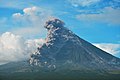 Mayon Volcano eruption at Daraga Church
 -
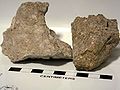 Bishop Tuff
 -
 Pyroclastic Flow
 -
 Pyroclastic Flow St. Helens
 -
 Pompeii Garden of the Fugitives


