Corporal punishment: Difference between revisions
CSV import |
CSV import |
||
| Line 31: | Line 31: | ||
[[Category:Punishments]] | [[Category:Punishments]] | ||
{{dictionary-stub1}} | {{dictionary-stub1}} | ||
<gallery> | |||
File:Whipping_of_an_incarcerated_delinquent,_Germany_17th_century.jpg|Whipping of an incarcerated delinquent, Germany 17th century | |||
File:Flogging.jpg|Flogging | |||
File:Falaka-Iran.jpg|Falaka Iran | |||
File:Koerperstrafe-_MA_Birkenrute.png|Koerperstrafe MA Birkenrute | |||
File:Women's_prison_punishment_(early_modern_era).jpg|Women's prison punishment (early modern era) | |||
File:Jean-Baptiste_Le_Prince,_Supplice_des_batogues_(c._1765–1766).png|Jean-Baptiste Le Prince, Supplice des batogues (c. 1765–1766) | |||
File:Husaga_(teckning_av_Fritz_von_Dardel).jpg|Husaga (teckning av Fritz von Dardel) | |||
File:Corporal_punishment_in_the_world.svg|Corporal punishment in the world | |||
File:School_corporal_punishment_USA_map.svg|School corporal punishment USA map | |||
File:Corporal_punishment_in_Europe.svg|Corporal punishment in Europe | |||
File:Ending_physical_punishment_in_Wales_-_English_version.webm|Ending physical punishment in Wales - English version | |||
File:Map_of_judicial_corporal_punishment.svg|Map of judicial corporal punishment | |||
</gallery> | |||
Latest revision as of 21:33, 23 February 2025
Corporal punishment is a form of physical punishment that involves the deliberate infliction of pain as retribution for an offence, or for the purpose of disciplining or reforming a wrongdoer, or to deter attitudes or behaviour deemed unacceptable. The term usually refers to methodically striking the offender with an implement, whether in judicial, domestic, or educational settings.
Definition[edit]
Corporal punishment can be defined as physical punishment that is meted out by an authority figure as a disciplinary measure. This can include spanking, paddling, caning, flogging, or whipping. The punishment is intended to cause physical pain, without any lasting physical injury. It is most often used where there is a substantial disparity of power between punisher and punished.
History[edit]
Corporal punishment was recorded as early as the 10th Century BC in Book of Proverbs attributed to Solomon: "He that spareth the rod hateth his son: but he that loveth him correcteth him betimes." With the growth of civilizations, corporal punishment became more organized and regulated. From the 16th century onwards, new trends were seen in corporal punishment. Judicial punishments were increasingly turned into public spectacles, with public beatings of criminals intended as a deterrent to other would-be offenders.
Modern Use[edit]
In the modern era, corporal punishment has been largely rejected in the western world, while remaining in use by some other societies. In many schools worldwide, corporal punishment has been outlawed, but domestic corporal punishment is still commonly used in many countries.
Effects[edit]
The effects of corporal punishment have been the subject of many studies. These studies tend to show that corporal punishment does not teach children the reasons for correct behavior, and instead may harm their self-esteem and mental health.
See Also[edit]
References[edit]
<references />
 | |
|---|---|
 |
 |
-
 Whipping of an incarcerated delinquent, Germany 17th century
 -
 Flogging
 -
 Falaka Iran
 -
 Koerperstrafe MA Birkenrute
 -
 Women's prison punishment (early modern era)
 -
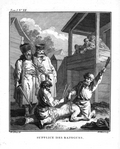 Jean-Baptiste Le Prince, Supplice des batogues (c. 1765–1766)
 -
 Husaga (teckning av Fritz von Dardel)
 -
 Corporal punishment in the world
 -
 School corporal punishment USA map
 -
 Corporal punishment in Europe
 -
 Ending physical punishment in Wales - English version
 -
 Map of judicial corporal punishment


.jpg)
.png)
.jpg)


