Nacre: Difference between revisions
CSV import |
CSV import |
||
| Line 21: | Line 21: | ||
{{stub}} | {{stub}} | ||
{{dictionary-stub1}} | {{dictionary-stub1}} | ||
== Nacre == | |||
<gallery> | |||
File:NautilusCutawayLogarithmicSpiral.jpg|Nautilus Cutaway Logarithmic Spiral | |||
File:Masa_perłowa3.jpg|Masa perłowa | |||
File:Nacre_microscopic_structure.png|Nacre Microscopic Structure | |||
File:Bruchfläche_eines_Perlmuttstücks.JPG|Bruchfläche eines Perlmuttstücks | |||
File:Fossil_nautiloid_shell_with_original_iridescent_nacre_in_fossiliferous_asphaltic_limestone.jpg|Fossil Nautiloid Shell with Original Iridescent Nacre in Fossiliferous Asphaltic Limestone | |||
File:Nacre_sticks.JPG|Nacre Sticks | |||
File:Flügelretabel_Perlmutt_Augsburg_um_1520.jpg|Flügelretabel Perlmutt Augsburg um 1520 | |||
File:Powder_flask_img_2091.jpg|Powder Flask | |||
File:Istanbul.Topkapi046.jpg|Istanbul Topkapi | |||
File:Ile_Salomon_Pendentif_MHNT_ETH_AC_SL_23_Roquemaurel.jpg|Ile Salomon Pendentif | |||
</gallery> | |||
Latest revision as of 21:32, 23 February 2025
Nacre also known as mother of pearl, is an organic-inorganic composite material produced by some molluscs as an inner shell layer. It is also the material that makes up the outer coating of pearls. It is strong, resilient, and iridescent.
Structure and properties[edit]
Nacre is composed of hexagonal platelets of aragonite (a form of calcium carbonate) 10–20 µm wide and 0.5 µm thick arranged in a continuous parallel lamina. These layers are separated by sheets of organic matrix composed of elastic biopolymers (such as chitin, lustrin and silk-like proteins). This mixture of brittle platelets and the thin layers of elastic biopolymers makes the material strong and resilient, with a Young's modulus of up to 70 GPa. Strength and resilience are also likely to be due to adhesion by the epithelial cells which are arranged in a continuous layer around the particles of aragonite.
Formation[edit]
Nacre formation is a result of a biological process called biomineralization. In the case of nacre, the process is controlled by the organism, which deposits aragonite and conchiolin in a specific manner to create the structure of nacre.
Uses[edit]
Nacre has been used for thousands of years for its decorative qualities in jewelry, buttons, watch faces, and inlay in furniture and musical instruments. It is also used in the construction of musical instruments, particularly those in the violin family.
See also[edit]
 | |
|---|---|
 |
 |
Nacre[edit]
-
 Nautilus Cutaway Logarithmic Spiral
 -
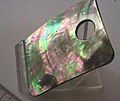 Masa perłowa
 -
 Nacre Microscopic Structure
 -
 Bruchfläche eines Perlmuttstücks
 -
 Fossil Nautiloid Shell with Original Iridescent Nacre in Fossiliferous Asphaltic Limestone
 -
 Nacre Sticks
 -
 Flügelretabel Perlmutt Augsburg um 1520
 -
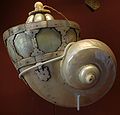 Powder Flask
 -
 Istanbul Topkapi
 -
 Ile Salomon Pendentif


