Earthworm: Difference between revisions
CSV import |
CSV import |
||
| Line 25: | Line 25: | ||
[[Category:Composting]] | [[Category:Composting]] | ||
{{stub}} | {{stub}} | ||
<gallery> | |||
File:Earthworm.JPG|Earthworm | |||
File:Earthworm_head.svg|Earthworm head | |||
File:Annelid_redone_w_white_background.svg|Annelid redone with white background | |||
File:Earthworm_nervous_system.png|Earthworm nervous system | |||
File:Earthworm_setae.jpg|Earthworm setae | |||
File:Earthworm_-_tokyo_area_-_May_6_2021.webm|Earthworm - Tokyo area - May 6 2021 | |||
File:Mating_earthworms.jpg|Mating earthworms | |||
File:Earthworm_-_L._terrestris_cocoons.jpg|Earthworm - L. terrestris cocoons | |||
File:Earthworm_egg.jpg|Earthworm egg | |||
File:Close_up_of_earthworm.jpg|Close up of earthworm | |||
File:Earthworm_-_L._terrestris_permanent_vertical_burrow.jpg|Earthworm - L. terrestris permanent vertical burrow | |||
File:Staphylinus.olens.vs.lumbricus.terrestris.jpg|Staphylinus olens vs Lumbricus terrestris | |||
</gallery> | |||
Latest revision as of 21:29, 23 February 2025
Earthworm is a type of worm that is commonly found in soil. They are part of the phylum Annelida and the class Clitellata. Earthworms are known for their role in soil fertility and are often used in composting.
Anatomy[edit]
Earthworms have a segmented body, with each segment containing a set of organs. The body is covered by a thin cuticle, which protects the worm from the environment. The anterior end of the worm contains the mouth and the posterior end contains the anus. The digestive system of the earthworm is a straight tube that runs from the mouth to the anus. Earthworms also have a closed circulatory system, with a dorsal blood vessel that carries blood to the anterior end of the worm and a ventral blood vessel that carries blood to the posterior end.
Ecology[edit]
Earthworms play a crucial role in the ecosystem. They are known as "ecosystem engineers" because they significantly alter the physical and chemical properties of the soil. They do this by burrowing through the soil, which improves soil structure and water movement. They also consume organic matter, which they excrete as casts. These casts are rich in nutrients and help to improve soil fertility.
Reproduction[edit]
Earthworms are hermaphrodites, meaning they have both male and female reproductive organs. However, they cannot self-fertilize and must mate with another earthworm to reproduce. During mating, two earthworms align their bodies and exchange sperm. The sperm is stored in sacs until the eggs are ready to be fertilized. After fertilization, a cocoon is formed around the eggs, which is then deposited in the soil. The young earthworms emerge from the cocoon after a few weeks.
Human use[edit]
Earthworms have been used by humans for various purposes. They are often used in composting, where they help to break down organic matter and produce nutrient-rich compost. They are also used in vermiculture, the practice of breeding and raising earthworms for use in composting and as bait for fishing.
See also[edit]
References[edit]
<references />
 | |
|---|---|
 |
 |
-
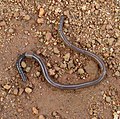 Earthworm
 -
 Earthworm head
 -
 Annelid redone with white background
 -
 Earthworm nervous system
 -
 Earthworm setae
 -
 Earthworm - Tokyo area - May 6 2021
 -
 Mating earthworms
 -
 Earthworm - L. terrestris cocoons
 -
 Earthworm egg
 -
 Close up of earthworm
 -
 Earthworm - L. terrestris permanent vertical burrow
 -
 Staphylinus olens vs Lumbricus terrestris


