Dead Sea: Difference between revisions
CSV import |
CSV import |
||
| Line 24: | Line 24: | ||
[[Category:Health]] | [[Category:Health]] | ||
[[Category:Therapies]] | [[Category:Therapies]] | ||
<gallery> | |||
File:Dead_Sea_beach_00.JPG|Dead Sea beach | |||
File:Channel2_-_Dead_Sea.webm|Channel 2 - Dead Sea | |||
File:Dead_Sea_Galilee.jpg|Dead Sea Galilee | |||
File:Dead_Sea,_Jordanian_Shore.jpg|Dead Sea, Jordanian Shore | |||
File:ISS-55_Nile_River_delta,_Egypt.jpg|ISS-55 Nile River delta, Egypt | |||
File:Dead_Sea_Halite_View_031712.jpg|Dead Sea Halite View | |||
File:SaltCementedPebblesDeadSea.JPG|Salt Cemented Pebbles Dead Sea | |||
File:Halite_Dead_Sea_Beach_Pebbles.JPG|Halite Dead Sea Beach Pebbles | |||
File:Dead_Sea_Sunrise.jpg|Dead Sea Sunrise | |||
File:MountSodom061607.jpg|Mount Sodom | |||
File:Madaba_BW_9_THERMA_KALLIROIS_highlighted.jpg|Madaba BW 9 THERMA KALLIROIS highlighted | |||
File:IRBY(1823)_p507_SKETCH_OF_THE_BACKWATER_AT_THE_SOUTH_END_OF_THE_DEAD_SEA.jpg|Sketch of the Backwater at the South End of the Dead Sea | |||
</gallery> | |||
Latest revision as of 21:28, 23 February 2025
Dead Sea is a salt lake bordered by Jordan to the east and Israel and Palestine to the west. Its surface and shores are 430.5 metres (1,412 ft) below sea level, Earth's lowest elevation on land. The Dead Sea is 304 m (997 ft) deep, the deepest hypersaline lake in the world. It is also one of the world's saltiest bodies of water, with a salinity of 34.2%, it is 9.6 times as salty as the ocean. This salinity makes for a harsh environment in which plants and animals cannot flourish, hence its name. The Dead Sea is 50 kilometres (31 mi) long and 15 kilometres (9 mi) wide at its widest point. It lies in the Jordan Rift Valley, and its main tributary is the Jordan River.
Geography[edit]
The Dead Sea, an endorheic lake located in the Jordan Rift Valley, a geographic feature formed by the Dead Sea Transform (DST). This left lateral-moving transform fault lies along the tectonic plate boundary between the African Plate and the Arabian Plate. It runs between the East Anatolian Fault zone in Turkey and the northern end of the Red Sea Rift offshore of the southern tip of Sinai.
Climate[edit]
The climate at the Dead Sea varies. In the winter, sea temperatures tend to be higher than land temperatures, and vice versa in the summer months. This is due to the depth of the sea, which allows it to absorb the sun's rays and retain heat longer than the land.
Health effects and therapies[edit]
The Dead Sea area has become a major center for health research and treatment for several reasons. The mineral content of the water, the very low content of pollens and other allergens in the atmosphere, the reduced ultraviolet component of solar radiation, and the higher atmospheric pressure at this great depth each have specific health effects.
See also[edit]
References[edit]
<references />
 | |
|---|---|
 |
 |
-
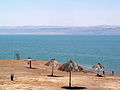 Dead Sea beach
 -
 Channel 2 - Dead Sea
 -
 Dead Sea Galilee
 -
 Dead Sea, Jordanian Shore
 -
 ISS-55 Nile River delta, Egypt
 -
 Dead Sea Halite View
 -
 Salt Cemented Pebbles Dead Sea
 -
 Halite Dead Sea Beach Pebbles
 -
 Dead Sea Sunrise
 -
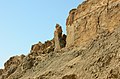 Mount Sodom
 -
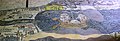 Madaba BW 9 THERMA KALLIROIS highlighted
 -
 Sketch of the Backwater at the South End of the Dead Sea


_p507_SKETCH_OF_THE_BACKWATER_AT_THE_SOUTH_END_OF_THE_DEAD_SEA.jpg)
