Angular momentum: Difference between revisions
CSV import |
CSV import Tags: mobile edit mobile web edit |
||
| Line 33: | Line 33: | ||
{{physics-stub}} | {{physics-stub}} | ||
== Angular_momentum == | |||
<gallery> | |||
File:Gyroskop.jpg|Gyroskop | |||
File:Ang_mom_2d.png|Ang mom 2d | |||
File:Torque_animation.gif|Torque animation | |||
File:Moment_of_inertia_examples.gif|Moment of inertia examples | |||
File:Cup_of_Russia_2010_-_Yuko_Kawaguti_(2).jpg|Cup of Russia 2010 - Yuko Kawaguti | |||
File:PrecessionOfATop.svg|Precession Of A Top | |||
File:Ang_mom_vector_diagram.png|Ang mom vector diagram | |||
File:Angular_momentum_bivector_and_pseudovector.svg|Angular momentum bivector and pseudovector | |||
File:Classical_angular_momentum.svg|Classical angular momentum | |||
File:Circular_Standing_Wave.gif|Circular Standing Wave | |||
File:Video_of_a_complete_use_session_with_a_gyroscopic_exercise_tool.webm|Video of a complete use session with a gyroscopic exercise tool | |||
File:Newton_area_law_derivation.gif|Newton area law derivation | |||
</gallery> | |||
Latest revision as of 21:24, 23 February 2025
Angular momentum is a vector quantity that represents the rotational momentum of a system. It is a fundamental concept in physics, particularly in the study of rotational motion. Angular momentum is conserved in a system where there is no net external torque, meaning that the total angular momentum of the objects in the system remains constant.
Definition[edit]
Angular momentum L is defined as the cross product of the position vector r and linear momentum p, given by the equation:
- L = r x p
In this equation, 'x' denotes the cross product, which combines the magnitudes and directions of the vectors in a specific way. The result is a new vector that is perpendicular to the plane formed by r and p.
Conservation of Angular Momentum[edit]
The conservation of angular momentum is a fundamental principle in physics. It states that if no external torque acts on a system, the total angular momentum of the system remains constant. This principle is a direct consequence of Newton's laws of motion.
Applications[edit]
Angular momentum has many applications in various fields of physics, including classical mechanics, quantum mechanics, and astrophysics. For example, in astrophysics, the conservation of angular momentum explains the rotation of stars and galaxies. In quantum mechanics, angular momentum is associated with particles spinning around their own axis.
See Also[edit]
- Momentum
- Torque
- Rotational motion
- Conservation laws
- Classical mechanics
- Quantum mechanics
- Astrophysics

Angular_momentum[edit]
-
 Gyroskop
 -
 Ang mom 2d
 -
 Torque animation
 -
 Moment of inertia examples
 -
 Cup of Russia 2010 - Yuko Kawaguti
 -
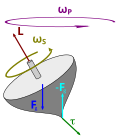 Precession Of A Top
 -
 Ang mom vector diagram
 -
 Angular momentum bivector and pseudovector
 -
 Classical angular momentum
 -
 Circular Standing Wave
 -
 Video of a complete use session with a gyroscopic exercise tool
 -
 Newton area law derivation


.jpg)


