Scientific notation: Difference between revisions
CSV import |
CSV import |
||
| Line 28: | Line 28: | ||
{{math-stub}} | {{math-stub}} | ||
<gallery> | |||
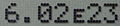
File:Avogadro's_number_in_e_notation.jpg|Avogadro's number in e notation | |||
</gallery> | |||
Latest revision as of 21:24, 23 February 2025
Scientific notation is a way of expressing numbers that are too large or too small to be conveniently written in decimal form. It is commonly used in science, engineering, and mathematics to make calculations simpler and to clearly represent the precision of numbers. Scientific notation has two parts: a coefficient and a power of ten. The coefficient is a number greater than or equal to 1 and less than 10, and it is multiplied by 10 raised to an exponent. The exponent indicates how many places the decimal point has been moved. The general form of a number in scientific notation is \(a \times 10^n\), where \(a\) is the coefficient and \(n\) is the exponent.
Usage[edit]
Scientific notation is particularly useful for expressing very large numbers, such as the distance between stars in astronomy, or very small numbers, like the mass of a molecule in chemistry. It simplifies calculations by allowing the manipulation of the exponents of ten, rather than dealing with long strings of zeros in decimal notation.
Conversion[edit]
To convert a number into scientific notation, one must move the decimal point to the position where the number becomes \(a\), where \(1 \leq a < 10\), and then count the number of places \(n\) the decimal has moved. If the decimal moves to the left, \(n\) is positive; if the decimal moves to the right, \(n\) is negative.
Example[edit]
To convert 123,000 into scientific notation, move the decimal point to between 1 and 2, resulting in 1.23. Since the decimal point moved 5 places to the left, the exponent is +5. Thus, 123,000 in scientific notation is \(1.23 \times 10^5\).
Advantages[edit]
The use of scientific notation allows for easier comparison of orders of magnitude and simplifies arithmetic operations. For example, multiplying and dividing numbers in scientific notation involves combining the coefficients and adding or subtracting the exponents, respectively.
Limitations[edit]
While scientific notation is invaluable in many fields, it may not be suitable for all contexts. For instance, in everyday life or when exact values are required without approximation, standard decimal notation is often preferred.
See Also[edit]

This article is a mathematics-related stub. You can help WikiMD by expanding it!
-
 Avogadro's number in e notation

