Coronaviridae: Difference between revisions
CSV import Tags: mobile edit mobile web edit |
CSV import |
||
| Line 30: | Line 30: | ||
{{Virus-stub}} | {{Virus-stub}} | ||
== Coronaviridae == | |||
<gallery> | |||
File:Viruses-07-01700-g003.jpg|Viruses-07-01700-g003 | |||
File:Viruses-07-01700-g002.jpg|Viruses-07-01700-g002 | |||
File:12985_2015_421_Fig2_HTML.webp|12985_2015_421_Fig2_HTML | |||
File:Water-12-01598-g001.png|Water-12-01598-g001 | |||
File:44149_2021_5_Fig3_HTML.webp|44149_2021_5_Fig3_HTML | |||
</gallery> | |||
Latest revision as of 21:23, 23 February 2025
Coronaviridae is a family of viruses known for containing strains that cause potentially lethal diseases in mammals and birds. In humans, these viruses are capable of causing respiratory infections ranging from the common cold to more severe diseases such as Middle East Respiratory Syndrome (MERS) and Severe Acute Respiratory Syndrome (SARS). The most recently discovered coronavirus causes coronavirus disease 2019 (COVID-19), which has led to the ongoing global pandemic.
Structure and Classification[edit]
Coronaviruses are enveloped viruses with a positive-sense single-stranded RNA genome and a nucleocapsid of helical symmetry. The genome size of coronaviruses ranges from approximately 26 to 32 kilobases, the largest among known RNA viruses. The name coronavirus is derived from the Latin corona, meaning "crown" or "halo", which refers to the characteristic appearance of the virus particles (virions): they have a fringe of large, bulbous surface projections creating an image reminiscent of a royal crown or of the solar corona.
Coronaviridae is divided into two subfamilies: Orthocoronavirinae and Letovirinae. The Orthocoronavirinae subfamily is further divided into four genera:
Alphacoronaviruses and betacoronaviruses infect mammals, gammacoronaviruses infect birds, and deltacoronaviruses infect both birds and mammals.
Pathogenesis[edit]
The infection process of coronaviruses involves the virus particle attaching to its complementary host cell receptor, followed by fusion of the viral envelope with the host membrane, allowing the virus to enter the host cell. Once inside the host cell, the virus particle releases its RNA genome into the cytoplasm and begins to replicate using the host's cellular machinery. The replication process results in the production of new virus particles, which are then released from the host cell and can infect adjacent cells or be exhaled by the host, spreading the infection.
Diseases[edit]
Coronaviruses are known to infect a range of hosts and cause various diseases. In humans, these viruses can cause mild illnesses such as the common cold as well as more severe diseases like SARS, MERS, and COVID-19. Symptoms of coronavirus infections can include fever, cough, shortness of breath, and in severe cases, pneumonia.
Prevention and Treatment[edit]
Preventive measures for coronavirus infections include regular hand washing, covering mouth and nose when coughing and sneezing, thoroughly cooking meat and eggs, and avoiding close contact with anyone showing symptoms of respiratory illness. As of my last update, there are vaccines available for COVID-19, which have been shown to be effective in preventing infection or reducing the severity of the disease.
Treatment options for coronavirus infections are primarily supportive and include rest, fluid intake, and the use of analgesics and antipyretics. Antiviral medications and immunotherapies are being researched and developed for more severe cases such as those caused by SARS, MERS, and COVID-19.
Epidemiology[edit]
Coronaviruses are globally distributed and have been implicated in periodic outbreaks of respiratory illnesses in humans. The transmission of these viruses can occur through respiratory droplets, direct contact with infected individuals, or contact with contaminated surfaces and objects. The emergence of new coronavirus strains that can infect humans, such as SARS-CoV, MERS-CoV, and SARS-CoV-2, poses significant challenges to public health worldwide.

[edit]
-
 Viruses-07-01700-g003
 -
 Viruses-07-01700-g002
 -
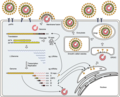 12985_2015_421_Fig2_HTML
 -
 Water-12-01598-g001
 -
 44149_2021_5_Fig3_HTML


