Mummy: Difference between revisions
CSV import Tags: mobile edit mobile web edit |
CSV import |
||
| Line 33: | Line 33: | ||
{{stub}} | {{stub}} | ||
<gallery> | |||
File:Ramses_I_Mummy.jpg|Ramses I Mummy | |||
File:Tuts_Tomb_Opened.JPG|Tut's Tomb Opened | |||
File:US_Navy_110427-N-2531L-135_Tori_Randall,_Ph.D._prepares_a_550-year_old_Peruvian_child_mummy_for_a_CT_scan.jpg|Preparing a 550-year-old Peruvian child mummy for a CT scan | |||
File:Mummy_at_British_Museum.jpg|Mummy at British Museum | |||
File:Bemalte_Mumienbinde.JPG|Painted Mummy Bandage | |||
File:Egyptian_Human_Mummy_-_Egyptian_Gallery_-_Indian_Museum_-_Kolkata_2014-02-14_3293.JPG|Egyptian Human Mummy at Indian Museum | |||
File:This_wooden_mummy_label_was_inscribed_in_black_ink._The_original_cord_is_still_in_situ._Roman_Period._From_Hawara,_Fayum,_Egypt._The_Petrie_Museum_of_Egyptian_Archaeology,_London.jpg|Wooden Mummy Label from Roman Period | |||
File:Mòmia_Nesi_BMVB_2964.jpg|Mòmia Nesi | |||
File:Mummification_simple.png|Mummification Process | |||
File:MNH_-_Mumie_Mann_1.jpg|MNH Mummy Man | |||
File:Momie_de_Jingzhou.jpg|Momie de Jingzhou | |||
File:Xin_Zhui_3.JPG|Xin Zhui | |||
</gallery> | |||
Latest revision as of 21:22, 23 February 2025
Mummy is a term used to describe the body of a person or animal that has been preserved after death. This can occur naturally, or it can be done intentionally using various methods. The process of mummification has been practiced by numerous cultures throughout history, most notably by the ancient Egyptians.
History[edit]
The practice of mummification dates back thousands of years. The oldest known mummies were found in the Atacama Desert in Chile and date back to around 5050 BC. However, the most well-known mummies are those of the ancient Egyptians, who began mummifying their dead around 2600 BC.
Process[edit]
The process of mummification varies greatly depending on the culture and time period. In ancient Egypt, the process involved removing the internal organs, treating the body with natron (a type of salt) to dry it out, and then wrapping it in linen bandages. Other cultures have used different methods, such as smoking or freezing.
Cultural Significance[edit]
Mummies hold significant cultural and historical value. They can provide valuable insights into the customs, beliefs, and lifestyles of the people who created them. In addition, they can also provide important information about diseases and medical practices of the past.
Modern Mummies[edit]
In modern times, mummification is not commonly practiced. However, there are some exceptions. For example, the body of the Buddhist monk Dashi-Dorzho Itigilov was found to be naturally mummified after his death in 1927.
See Also[edit]
References[edit]
<references />
 | |
|---|---|
 |
 |
-
 Ramses I Mummy
 -
 Tut's Tomb Opened
 -
 Preparing a 550-year-old Peruvian child mummy for a CT scan
 -
 Mummy at British Museum
 -
 Painted Mummy Bandage
 -
 Egyptian Human Mummy at Indian Museum
 -
 Wooden Mummy Label from Roman Period
 -
 Mòmia Nesi
 -
 Mummification Process
 -
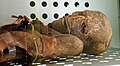 MNH Mummy Man
 -
 Momie de Jingzhou
 -
 Xin Zhui


