Shadow: Difference between revisions
CSV import |
CSV import |
||
| Line 33: | Line 33: | ||
{{stub}} | {{stub}} | ||
<gallery> | |||
File:The_shadow_of_a_musician_playing_transverse_flute.jpg|The shadow of a musician playing transverse flute | |||
File:Park_grid.JPG|Park grid | |||
File:Cumulus_cloud_shadows_1.jpg|Cumulus cloud shadows | |||
File:Diagram_of_umbra,_penumbra_&_antumbra.png|Diagram of umbra, penumbra & antumbra | |||
File:Three_moons_and_their_shadows_parade_across_Jupiter.jpg|Three moons and their shadows parade across Jupiter | |||
File:Steam_phase_eruption_of_Castle_Geyser_with_crepuscular_rays_and_shadow.jpg|Steam phase eruption of Castle Geyser with crepuscular rays and shadow | |||
File:Fog_shadow_of_GGB.jpg|Fog shadow of GGB | |||
File:Moonlight_shadow.jpg|Moonlight shadow | |||
File:Apollo_9_astronaut_Dave_Scott.jpg|Apollo 9 astronaut Dave Scott | |||
File:British_Library_Gate_Shadow.jpg|British Library Gate Shadow | |||
File:Fog_shadow_tv_tower.jpg|Fog shadow tv tower | |||
File:Jasminum_sambac1SHSU.jpg|Jasminum sambac | |||
</gallery> | |||
Latest revision as of 21:20, 23 February 2025
Shadow is a dark area where light from a light source is blocked by an opaque object. It occupies all of the three-dimensional volume behind an object with light in front of it. The cross section of a shadow is a two-dimensional silhouette, or a reverse projection of the object blocking the light.
Physics[edit]
A shadow is a dark (real image) area where light from a light source is blocked by an opaque object. It occupies all of the three-dimensional volume behind an object with light in front of it. The cross section of a shadow is a two-dimensional silhouette, or a reverse projection of the object blocking the light.
Point and non-point light sources[edit]
A point source of light casts only a simple shadow, called an "umbra". For a non-point or "extended" source of light, the shadow is divided into the umbra, penumbra and antumbra. The wider the light source, the more blurred the shadow becomes. If two penumbras overlap, the shadows appear to attract and merge. This is known as the Shadow Blister Effect.
Shadow propagation speed[edit]
The farther the distance from the object blocking the light to the surface of projection, the larger the silhouette (they are considered proportional). Also, if the object is moving, the shadow cast by the object will project an image with dimensions (length) expanding proportionally faster than the object's own rate of movement. The increase of size and movement is also true if the distance between the object of interference and the light source increase.
Visual effects[edit]
With a single light source and a single object, multiple shadows can appear if there is more than one light source. The number of shadows and their direction depends on the direction and size of the light source(s) and the relative position of the object with respect to the light source(s).
Cultural aspects[edit]
Shadows have been used throughout history for a variety of purposes, including art and entertainment. They are also used in psychology, such as in the method of shadow work where an individual alters their cognitive perception of a shadow to enhance their emotional state.
See also[edit]
 | |
|---|---|
 |
 |
-
 The shadow of a musician playing transverse flute
 -
 Park grid
 -
 Cumulus cloud shadows
 -
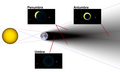 Diagram of umbra, penumbra & antumbra
 -
 Three moons and their shadows parade across Jupiter
 -
 Steam phase eruption of Castle Geyser with crepuscular rays and shadow
 -
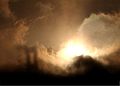 Fog shadow of GGB
 -
 Moonlight shadow
 -
Apollo 9 astronaut Dave Scott
-
British Library Gate Shadow
-
Fog shadow tv tower
-
Jasminum sambac


