Berberis vulgaris: Difference between revisions
CSV import Tags: mobile edit mobile web edit |
CSV import |
||
| Line 23: | Line 23: | ||
[[Category:Flora of North America]] | [[Category:Flora of North America]] | ||
{{Flora-stub}} | {{Flora-stub}} | ||
<gallery> | |||
File:Illustration_Berberis_vulgaris0.jpg|Illustration of Berberis vulgaris | |||
File:Berberis-vulgaris-flowers.jpg|Berberis vulgaris flowers | |||
File:歐洲小蘗_Berberis_vulgaris_-匈牙利布達佩斯_Budapest,_Hungary-_(9216101912).jpg|Berberis vulgaris in Budapest, Hungary | |||
File:Berberis_vulgaris_.jpg|Berberis vulgaris | |||
File:Dried_barberries_on_a_plate.JPG|Dried barberries on a plate | |||
</gallery> | |||
Latest revision as of 21:20, 23 February 2025
Berberis vulgaris, also known as barberry, is a species of shrub in the family Berberidaceae. It is native to central and southern Europe, northwest Africa, and western Asia. It is also naturalized in northern Europe, including the British Isles and Scandinavia, and North America.
Description[edit]
Berberis vulgaris is a deciduous shrub growing up to 4 meters high. The leaves are small oval, 2–5 cm long and 1–2 cm broad, with a serrated margin; they are borne in clusters of 2-5 together, subtended by a three-branched spine 3–8 mm long. The flowers are yellow, 4–6 mm across, produced on a simple raceme 20–50 mm long in late spring. The fruit is an oblong red berry 7–10 mm long and 3–5 mm broad, ripening in late summer or autumn; they are edible but very sour.
Cultivation and uses[edit]
Berberis vulgaris is cultivated for its fruits in many countries. The berries are edible and rich in vitamin C, though with a very sharp flavor. In Europe, the berries have been traditionally used as an ingredient in making jam. The plant is also grown as an ornamental plant in gardens for its attractive flowers and bright red berries.
The plant has a long history of medicinal use, dating back to ancient times. It has been used as a treatment for a variety of ailments, including digestive disorders, skin diseases, and infections. The plant contains several biologically active compounds, including berberine, which has been shown to have antimicrobial, anti-inflammatory, and antioxidant effects.
Ecology[edit]
Berberis vulgaris is a host plant for the larva of the moth species Argyresthia goedartella and Argyresthia conjugella. It is also a host plant for the rust fungus Puccinia graminis, a fungus that is very destructive to wheat crops. Because of this, cultivation of Berberis vulgaris is prohibited in many areas in the United States.
See also[edit]

This flora-related article is a stub. You can help WikiMD by expanding it.
-
 Illustration of Berberis vulgaris
 -
 Berberis vulgaris flowers
 -
 Berberis vulgaris in Budapest, Hungary
 -
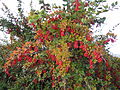 Berberis vulgaris
 -
 Dried barberries on a plate


.jpg)


