Robert Hooke: Difference between revisions
CSV import |
CSV import |
||
| Line 30: | Line 30: | ||
[[Category:1703 deaths]] | [[Category:1703 deaths]] | ||
{{stub}} | {{stub}} | ||
<gallery> | |||
File:Portrait_of_a_Mathematician_1680c.jpg|Portrait of a Mathematician | |||
File:Robert_Boyle_0001.jpg|Robert Boyle | |||
File:Acta_Eruditorum_-_III_fisica,_1707_–_BEIC_13369403.jpg|Acta Eruditorum - III fisica, 1707 | |||
File:Fotothek_df_tg_0003783_Uhr_^_Uhrwerk.jpg|Clockwork | |||
File:Hooke-microscope.png|Hooke Microscope | |||
File:Hooke_Microscope-03000276-FIG-4.jpg|Hooke Microscope Figure 4 | |||
File:Louse_diagram,_Micrographia,_Robert_Hooke,_1667.jpg|Louse diagram, Micrographia, Robert Hooke, 1667 | |||
File:HookeFlea01.jpg|Hooke Flea | |||
File:RobertHookeMicrographia1665.jpg|Robert Hooke Micrographia 1665 | |||
File:MK_WillenChurch01.JPG|Willen Church | |||
File:Bull_and_Mouth_Street_from_Ogilby_&_Morgan's_map.jpg|Bull and Mouth Street from Ogilby & Morgan's map | |||
File:Jan_Baptist_van_Helmont_portrait.jpg|Jan Baptist van Helmont portrait | |||
</gallery> | |||
Latest revision as of 21:19, 23 February 2025
Robert Hooke (18 July 1635 – 3 March 1703) was an English scientist, architect and polymath. His work, particularly in the sciences of biology and physics, has left a lasting legacy in the field of scientific study.
Early Life[edit]
Hooke was born in the town of Freshwater on the Isle of Wight. He was the youngest of four children. His father, John Hooke, was a curate for the local church.
Career[edit]
Hooke's career began as an assistant to the prominent scientist Robert Boyle. During this time, he made significant contributions to the construction of Boyle's air pump.
In 1662, Hooke was appointed as the Curator of Experiments to the Royal Society, a position he held until his death. In this role, he was responsible for demonstrating new experiments at the society's weekly meetings.
Hooke made numerous contributions to the field of science. He is perhaps best known for his law of elasticity, known as Hooke's Law, and his pioneering work in the field of microscopy. His book, Micrographia, was the first major publication on microscopy and included detailed drawings of the structure of insects and plants.
Death and Legacy[edit]
Hooke died in London in 1703. His contributions to science have been widely recognized and he is considered one of the most important scientists of his time.
See Also[edit]
References[edit]
<references />
External Links[edit]
 | |
|---|---|
 |
 |
-
 Portrait of a Mathematician
 -
 Robert Boyle
 -
 Acta Eruditorum - III fisica, 1707
 -
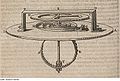 Clockwork
 -
 Hooke Microscope
 -
 Hooke Microscope Figure 4
 -
 Louse diagram, Micrographia, Robert Hooke, 1667
 -
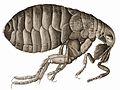 Hooke Flea
 -
 Robert Hooke Micrographia 1665
 -
 Willen Church
 -
 Bull and Mouth Street from Ogilby & Morgan's map
 -
 Jan Baptist van Helmont portrait


