Senecio: Difference between revisions
CSV import |
CSV import |
||
| Line 29: | Line 29: | ||
{{stub}} | {{stub}} | ||
== Senecio == | |||
<gallery> | |||
File:Illustration_Senecio_vulgaris0.jpg|Illustration of Senecio vulgaris | |||
File:Senecio_serpens_06.jpg|Senecio serpens | |||
File:Senecio.barbertonicus.7074.jpg|Senecio barbertonicus | |||
File:Senecio_haworthii-PICT2616.jpg|Senecio haworthii | |||
File:Senecio_madagascariensis_7th_Brigade_Park_Chermside_IMGP1941.jpg|Senecio madagascariensis | |||
File:Senecio_angulatus_habitat.jpg|Senecio angulatus habitat | |||
File:Senecio_macroglossus_2015-05-29_OB_168.jpg|Senecio macroglossus | |||
File:Senecio_elegans_Yallingup.jpg|Senecio elegans | |||
</gallery> | |||
Latest revision as of 21:19, 23 February 2025
Senecio is a genus of the daisy family that includes ragworts and groundsels. The scientific Latin genus name, Senecio, means "old man."
Description[edit]
Senecio species are often found in the wild in meadows, fields, and along roadsides. Many are garden ornamentals, and some are invasive species. Other species are used for medicinal purposes. They can be annuals, biennials, perennials, climbers, or shrubs. The leaves can be pinnate, simple, or lobed. The flower heads are normally rayed, completely yellow, and the heads are borne in branched clusters.
Distribution and habitat[edit]
Senecio is one of the largest genera of flowering plants, and despite the separation of many species into other genera it still contains around 1250 species of varied form, including leaf, stem and tuber succulents, annuals, perennials, aquatics, climbers, shrubs and small trees. Some species produce natural biocides (especially alkaloids) to deter or even kill animals that would eat them.
Toxicity[edit]
Senecio species are poisonous to humans and livestock. The toxic compounds in the plants are pyrrolizidine alkaloids, and can cause liver damage, cancer, and death.
Species[edit]
There are many species in the Senecio genus, including Senecio vulgaris, or common groundsel, and Senecio jacobaea, or ragwort.
See also[edit]
References[edit]
<references />
External links[edit]
 | This medical article is a stub. You can help WikiMD by expanding the page. |
Senecio[edit]
-
 Illustration of Senecio vulgaris
 -
 Senecio serpens
 -
 Senecio barbertonicus
 -
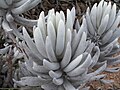 Senecio haworthii
 -
 Senecio madagascariensis
 -
 Senecio angulatus habitat
 -
 Senecio macroglossus
 -
 Senecio elegans


