Radar horizon: Difference between revisions
CSV import |
CSV import |
||
| Line 55: | Line 55: | ||
<references /> | <references /> | ||
{{dictionary-stub1}} | {{dictionary-stub1}} | ||
<gallery> | |||
File:Low_elevation_region.gif|Low elevation region | |||
</gallery> | |||
Latest revision as of 21:18, 23 February 2025
Radar Horizon[edit]
The radar horizon is a fundamental concept in radar technology that refers to the maximum distance at which a radar system can detect or track a target. It is determined by the curvature of the Earth and the height of the radar antenna above the ground. Understanding the radar horizon is crucial for optimizing radar performance and ensuring accurate target detection.
Calculation[edit]
The calculation of the radar horizon involves several factors, including the height of the radar antenna and the Earth's curvature. The formula used to calculate the radar horizon is:
``` R = 1.23 * sqrt(h) ```
Where: - R is the radar horizon in nautical miles - h is the height of the radar antenna in feet
This formula assumes a standard atmospheric refraction index of 4/3. It is important to note that the radar horizon is a line-of-sight distance and does not take into account obstacles such as buildings, mountains, or atmospheric conditions that may affect radar performance.
Importance[edit]
Understanding the radar horizon is crucial for various applications of radar technology. For example, in maritime radar systems, knowing the radar horizon helps determine the maximum range at which ships or other objects can be detected. This information is vital for navigation, collision avoidance, and search and rescue operations at sea.
In aviation, the radar horizon plays a significant role in air traffic control and weather monitoring. By knowing the radar horizon, air traffic controllers can determine the coverage area of radar systems and ensure safe separation between aircraft. Additionally, meteorologists rely on radar horizon calculations to interpret weather radar data accurately.
Factors Affecting Radar Horizon[edit]
Several factors can affect the radar horizon, including the height of the radar antenna, the frequency of the radar signal, and the atmospheric conditions. Higher antenna heights generally result in a longer radar horizon, as the line of sight extends further due to the Earth's curvature. Similarly, lower frequencies tend to have a longer radar horizon compared to higher frequencies.
Atmospheric conditions, such as temperature inversions or precipitation, can affect radar performance and reduce the effective radar horizon. These conditions can cause signal attenuation or scattering, leading to decreased detection range.
Applications[edit]
The concept of radar horizon has numerous applications across various industries. Some notable applications include:
1. Maritime Navigation: Radar systems on ships use the radar horizon to determine the range at which other vessels or obstacles can be detected, aiding in safe navigation.
2. Air Traffic Control: Radar systems in aviation rely on the radar horizon to establish the coverage area and ensure safe separation between aircraft.
3. Weather Monitoring: Meteorologists use radar horizon calculations to interpret weather radar data accurately and predict severe weather conditions.
4. Military Surveillance: Radar systems are extensively used in military applications for surveillance, target detection, and tracking. Understanding the radar horizon helps optimize the performance of these systems.
Conclusion[edit]
The radar horizon is a fundamental concept in radar technology that determines the maximum distance at which a radar system can detect or track a target. By considering factors such as antenna height, frequency, and atmospheric conditions, engineers and operators can optimize radar performance and ensure accurate target detection. The radar horizon has significant applications in maritime navigation, air traffic control, weather monitoring, and military surveillance, making it a crucial concept in the field of radar technology.
See Also[edit]
References[edit]
<references />

-
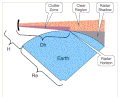 Low elevation region

