Particulates: Difference between revisions
CSV import |
CSV import Tags: mobile edit mobile web edit |
||
| Line 22: | Line 22: | ||
{{Climate change-stub}} | {{Climate change-stub}} | ||
{{Medicine-stub}} | {{Medicine-stub}} | ||
<gallery> | |||
File:PM_and_a_human_hair.jpg|PM and a human hair | |||
File:Airborne-particulate-size-chart.svg|Airborne particulate size chart | |||
File:Dust_emission_when_using_electrical_power_tools.webm|Dust emission when using electrical power tools | |||
File:Warsaw_Excavator_006.jpg|Warsaw Excavator | |||
File:Atmospheric_Aerosol_Eddies_and_Flows_-_NASA_GSFC_S.ogv|Atmospheric Aerosol Eddies and Flows | |||
File:MODAL2_M_AER_RA.ogv|MODAL2 M AER RA | |||
File:Display_VSON_WP6910_(air_detector)_-_pm2,5_at_Verona_(Borgo_Milano)_Italy_-_(particulate_pollution,_polveri_sottili)_-_2020_01_15_(hour_22.35)_OUTdoor_&_INdoor_(HEPA_H13)_-_first_publication_commons.wikimedia.org.webm|Display VSON WP6910 (air detector) - pm2.5 at Verona (Borgo Milano) Italy | |||
File:Construction_dust_emitted_and_rising_up_during_the_building_rehabilitation_of_Treasure_Garden,_Tai_Po,_Hong_Kong.webm|Construction dust emitted and rising up during the building rehabilitation of Treasure Garden, Tai Po, Hong Kong | |||
File:20231206_Radiative_forcing_(warming_influence)_-_global_warming.svg|Radiative forcing (warming influence) - global warming | |||
File:Modis_aerosol_optical_depth.png|Modis aerosol optical depth | |||
File:MODAL2_M_AER_OD.ogv|MODAL2 M AER OD | |||
File:Cloud_3.JPG|Cloud | |||
</gallery> | |||
Latest revision as of 21:15, 23 February 2025
Particulates or Particulate Matter (PM) are tiny pieces of solid or liquid matter associated with the Earth's atmosphere. They are suspended in the atmosphere as atmospheric aerosol, a term which refers to the particulate/air mixture, as opposed to the particulates alone. Sources of particulate matter can be natural or anthropogenic. They have impacts on climate and precipitation that adversely affect human health, in ways additional to direct inhalation.
Sources and Composition[edit]
Particulates can be derived from various sources both natural and anthropogenic. Natural sources include volcanoes, dust storms, forest and grassland fires, living vegetation, and sea spray. Human activities, such as the burning of fossil fuels and the alteration of natural surface cover, also generate significant amounts of particulates. Fuel burning in stationary sources, including residential wood burning, power plants, and industrial processes, as well as mobile sources such as automobiles, are among the major anthropogenic sources of particulates.
Health and Environmental Impact[edit]
Exposure to particulate matter can cause a number of health problems. For instance, it can lead to respiratory and cardiovascular issues, premature death, allergic reactions and other health problems. Particulates in the atmosphere also have an effect on the Earth's climate. Depending on their albedo (reflectivity), they can either cool the surface of the planet by reflecting sunlight back into space, or warm it by absorbing and re-radiating sunlight as heat.
Measurement and Regulation[edit]
The size of the particles is a main determinant of where in the respiratory tract the particles will come to rest when inhaled. Because of this, regulatory agencies such as the Environmental Protection Agency (EPA) in the United States have established standards and guidelines for PM measurements and emissions.
See Also[edit]

This article is a environment-related stub. You can help WikiMD by expanding it!
This climate change related article is a stub. You can help WikiMD by expanding it.

-
 PM and a human hair
 -
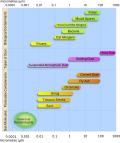 Airborne particulate size chart
 -
 Dust emission when using electrical power tools
 -
 Warsaw Excavator
 -
 Atmospheric Aerosol Eddies and Flows
 -
MODAL2 M AER RA
-
Display VSON WP6910 (air detector) - pm2.5 at Verona (Borgo Milano) Italy
-
Construction dust emitted and rising up during the building rehabilitation of Treasure Garden, Tai Po, Hong Kong
-
 Radiative forcing (warming influence) - global warming
 -
 Modis aerosol optical depth
 -
MODAL2 M AER OD
-
 Cloud
Cloud


_-_global_warming.svg)


