Mycovirus: Difference between revisions
CSV import Tags: mobile edit mobile web edit |
CSV import |
||
| Line 30: | Line 30: | ||
{{Virology-stub}} | {{Virology-stub}} | ||
{{Fungi-stub}} | {{Fungi-stub}} | ||
== Mycovirus == | |||
<gallery> | |||
File:Rycina_32_Mykowirusy_–_wirusy_infekujące_grzyby_J._Kamiński.png|Rycina 32 Mykowirusy – wirusy infekujące grzyby J. Kamiński | |||
File:Listing_of_all_formally_named_and_recognised_mycoviruses.png|Listing of all formally named and recognised mycoviruses | |||
</gallery> | |||
Latest revision as of 21:14, 23 February 2025
Mycovirus is a type of virus that infects fungi. The term "mycovirus" is derived from the Greek words "mykes" meaning fungus and "virus" meaning poison. Mycoviruses are widespread in all major fungal groups and are known to infect fungi that are pathogenic to humans and plants.
History[edit]
The first mycovirus was discovered in the 1960s in the cultivated mushroom Agaricus bisporus. Since then, many other mycoviruses have been identified in various fungal species.
Structure and Classification[edit]
Mycoviruses are classified into several families based on their genome structure and replication strategy. These include the families Totiviridae, Partitiviridae, Chrysoviridae, and Hypoviridae, among others.
Mycoviruses have diverse genome structures. Some have double-stranded RNA genomes, while others have single-stranded RNA or DNA genomes. The size of mycovirus genomes also varies widely, ranging from 2.4 to 17.6 kilobases.
Replication and Transmission[edit]
Mycoviruses replicate within the cytoplasm of their host cells. They do not have an extracellular phase and are transmitted from one cell to another through cell division or hyphal anastomosis.
Unlike most other viruses, mycoviruses do not cause lysis of their host cells. Instead, they often cause changes in the phenotype of their host, such as reduced virulence or altered growth rate.
Ecological and Economic Impact[edit]
Mycoviruses can have significant ecological and economic impacts. For example, they can reduce the virulence of fungal pathogens, thereby protecting plants and crops from disease. Some mycoviruses are also being explored as potential biocontrol agents for use in agriculture.
Research and Future Directions[edit]
Research on mycoviruses is a rapidly growing field. Future research directions include understanding the molecular mechanisms of mycovirus-host interactions, exploring the diversity of mycoviruses in nature, and developing mycoviruses as tools for controlling fungal diseases.
This virology related article is a stub. You can help WikiMD by expanding it.

Mycovirus[edit]
-
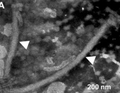 Rycina 32 Mykowirusy – wirusy infekujące grzyby J. Kamiński
 -
 Listing of all formally named and recognised mycoviruses


