Dubnium: Difference between revisions
CSV import |
CSV import |
||
| Line 43: | Line 43: | ||
[[Category:Synthetic elements]] | [[Category:Synthetic elements]] | ||
[[Category:Transition metals]] | [[Category:Transition metals]] | ||
== Dubnium == | |||
<gallery> | |||
File:Transactinide_chemistry_apparatus_Dubna.jpg|Transactinide chemistry apparatus Dubna | |||
File:Niels_Bohr.jpg|Niels Bohr | |||
File:Otto_Hahn_(Nobel).jpg|Otto Hahn (Nobel) | |||
File:Nucleus_half_life_and_decay.svg|Nucleus half life and decay | |||
File:7s_electrons_dubnium_relativistic_vs_nonrelativistic.svg|7s electrons dubnium relativistic vs nonrelativistic | |||
File:Atomic_orbitals_dubnium.svg|Atomic orbitals dubnium | |||
File:Radiochem_104+_Transactinide.svg|Radiochem 104+ Transactinide | |||
</gallery> | |||
Latest revision as of 21:12, 23 February 2025
Dubnium
Dubnium is a synthetic chemical element with the symbol Db and atomic number 105. It is a member of the transition metals and is part of the periodic table's d-block. Dubnium is not found naturally and must be created in a laboratory setting.
History[edit]
The discovery of dubnium was first reported in 1968 by a team of scientists at the Joint Institute for Nuclear Research in Dubna, Russia, and independently by researchers at the Lawrence Berkeley National Laboratory in California, USA. The element was named after the town of Dubna.
Properties[edit]
Physical Properties[edit]
Dubnium is a highly radioactive metal. Due to its short half-life, its physical properties are not well-characterized. It is expected to have properties similar to other group 5 elements, such as tantalum and niobium.
Chemical Properties[edit]
Dubnium is expected to exhibit oxidation states of +5 and possibly +3. Its chemistry is predicted to be similar to that of tantalum and niobium, forming complex compounds with oxygen and halogens.
Production[edit]
Dubnium is produced by bombarding lighter elements with charged particles. The most common method involves the fusion of calcium ions with americium or berkelium targets in a particle accelerator.
Isotopes[edit]
Dubnium has no stable isotopes. Several radioactive isotopes have been synthesized, with the most stable being dubnium-268, which has a half-life of about 28 hours.
Applications[edit]
Due to its radioactivity and short half-life, dubnium has no practical applications outside of scientific research. It is primarily used in studies to understand the properties of heavy elements and the forces that hold atomic nuclei together.
Safety[edit]
As a radioactive element, dubnium poses significant health risks if not handled properly. It requires specialized facilities and equipment to ensure safe handling and containment.
See Also[edit]
Chemical element with atomic number (Db)
Dubnium, 00Db
Dubnium[edit]
-
Transactinide chemistry apparatus Dubna
-
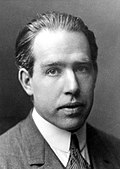 Niels Bohr
 -
 Otto Hahn (Nobel)
 -
 Nucleus half life and decay
 -
 7s electrons dubnium relativistic vs nonrelativistic
 -
 Atomic orbitals dubnium
 -
 Radiochem 104+ Transactinide

.jpg)


