Recycling: Difference between revisions
CSV import Tags: mobile edit mobile web edit |
CSV import |
||
| Line 31: | Line 31: | ||
[[Category:Environmental conservation]] | [[Category:Environmental conservation]] | ||
{{environment-stub}} | {{environment-stub}} | ||
<gallery> | |||
File:Recycling_symbol.svg|Recycling symbol | |||
File:Municipal_waste_recycling_rate_(%),_OWID.svg|Municipal waste recycling rate (%) | |||
File:Old_Rags_Into_New_Cloth-_Salvage_in_Britain,_April_1942_D7447.jpg|Old Rags Into New Cloth: Salvage in Britain, April 1942 | |||
File:Scrap^_Will_Help_Win._Don't_Mix_it_-_NARA_-_533983.jpg|Scrap Will Help Win. Don't Mix it | |||
File:INF3-196_Salvage_Still_more_paper,_rags,_bones_wanted_for_salvage_Artist_Gilroy.jpg|Salvage: Still more paper, rags, bones wanted for salvage | |||
File:Housewives!_Wage_War_on_Hitler_-_Save_-_DPLA_-_38319075b7298ab8ed2d9b792495f644.jpg|Housewives! Wage War on Hitler - Save | |||
File:YorkWhipMaFence2.jpg|York Whip Ma Fence | |||
File:A_RES_71_313_E.pdf|A RES 71 313 E | |||
File:Agbogbloshie_Ghana.jpg|Agbogbloshie, Ghana | |||
File:CLOSEUP_OF_BEER_BOTTLES_CRUSHED_INTO_FINE_GLASS._THIS_MIXTURE_IS_FED_INTO_THE_GLASS_FURNACE_AND_NEW_BOTTLES_ARE_MADE..._-_NARA_-_543695.jpg|Closeup of beer bottles crushed into fine glass | |||
File:DeutscheBahnRecycling20050814_CopyrightKaihsuTai_Rotated.jpg|Deutsche Bahn Recycling | |||
File:ACT_recycling_truck.jpg|ACT recycling truck | |||
</gallery> | |||
Latest revision as of 21:11, 23 February 2025
Recycling is the process of converting waste materials into new materials and objects. It is an alternative to "conventional" waste disposal that can save material and help lower greenhouse gas emissions. Recycling can prevent the waste of potentially useful materials and reduce the consumption of fresh raw materials, thereby reducing: energy usage, air pollution (from incineration), and water pollution (from landfilling).
History[edit]
Recycling has been a common practice for most of human history, with recorded advocates as far back as Plato in the fourth century BC. During periods when resources were scarce, archaeological studies of ancient waste dumps show less household waste (such as ash, broken tools, and pottery)—implying more waste was being recycled in the absence of new material.
Process[edit]
The recycling process involves three stages. The first stage is the collection, where waste materials are collected from different locations such as homes, businesses, and so on. These waste materials are then sorted and cleaned, to remove any impurities. The second stage is the manufacturing. Here, the waste materials are transformed into new products. The third stage is the selling of these new products to consumers.
Types of Recycling[edit]
There are several methods of recycling, including Mechanical recycling, Chemical recycling, and Organic recycling. Each method has its own set of advantages and disadvantages, and is used for different types of waste materials.
Benefits and Drawbacks[edit]
Recycling has a number of benefits, including the reduction of waste sent to landfills and incinerators, the conservation of natural resources such as timber, water, and minerals, and the prevention of pollution by reducing the need to collect new raw materials. However, recycling also has some drawbacks, such as the cost of recycling programs, the decrease in the quality of recycled products, and the issue of waste that cannot be recycled.
See Also[edit]
References[edit]
<references />

This article is a environment-related stub. You can help WikiMD by expanding it!
-
 Recycling symbol
 -
 Municipal waste recycling rate (%)
 -
 Old Rags Into New Cloth: Salvage in Britain, April 1942
 -
 Scrap Will Help Win. Don't Mix it
 -
 Salvage: Still more paper, rags, bones wanted for salvage
 -
 Housewives! Wage War on Hitler - Save
 -
 York Whip Ma Fence
 -
 A RES 71 313 E
 -
 Agbogbloshie, Ghana
 -
 Closeup of beer bottles crushed into fine glass
 -
 Deutsche Bahn Recycling
 -
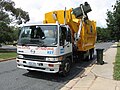 ACT recycling truck

,_OWID.svg)


