Literacy: Difference between revisions
CSV import Tags: mobile edit mobile web edit |
CSV import Tags: mobile edit mobile web edit |
||
| Line 27: | Line 27: | ||
{{stub}} | {{stub}} | ||
<gallery> | |||
File:Adult_literacy_rates,_2015_or_most_recent_observation,_OWID.svg|Adult literacy rates, 2015 or most recent observation | |||
File:World_illiteracy_1970-2010.svg|World illiteracy 1970-2010 | |||
File:Literacy-rate.svg|Literacy rate | |||
File:Illiteracy_france.png|Illiteracy in France | |||
File:Bill_of_sale_Louvre_AO3765.jpg|Bill of sale Louvre AO3765 | |||
File:Figure_1_Adult_literacy_rates_have_increased_Reading_the_past_writing_the_futureUPDATED.svg|Adult literacy rates have increased | |||
File:Figure_5_Literacy_has_rapidly_spread_Reading_the_past_writing_the_future.svg|Literacy has rapidly spread | |||
File:Adult_literacy_rate,_population_15+_years,_male_(%),_OWID.svg|Adult literacy rate, population 15+ years, male (%) | |||
File:Adult_literacy_rate,_population_15+_years,_female_(%),_OWID.svg|Adult literacy rate, population 15+ years, female (%) | |||
File:Figure_4_Progress_towards_gender_parity_Reading_the_past_writing_the_future.svg|Progress towards gender parity | |||
File:Youth_and_adult_literacy_rate,_2000–2016_and_projections_to_2030.svg|Youth and adult literacy rate, 2000–2016 and projections to 2030 | |||
File:Students-in-grade-2-who-cant-read-a-single-word-ca-2015.png|Students in grade 2 who can't read a single word ca 2015 | |||
</gallery> | |||
Latest revision as of 21:10, 23 February 2025
Literacy is the ability to read, write, and understand a particular language. It is a fundamental skill that enables individuals to function effectively in society. Literacy skills are crucial for personal development, social communication, and participation in various social, economic, and political activities.
Definition[edit]
Literacy is traditionally understood as the ability to read, write, and use arithmetic. The modern term's meaning has been expanded to include the ability to use language, numbers, images, computers, and other basic means to understand, communicate, gain useful knowledge, solve mathematical problems and use the dominant symbol systems of a culture.
History[edit]
The history of literacy is a part of the history of writing. The earliest forms of written communication originated in Sumer, located in southern Mesopotamia about 3500-3000 BCE. During this era, literacy was a largely functional matter, propelled by the need to manage the new quantities of information and the new type of governance created by trade and large scale production.
Literacy and Society[edit]
Literacy is a key lever of change and a practical tool of empowerment on each of the three main pillars of sustainable development: economic development, social development and environmental protection.
Global Literacy[edit]
UNESCO has been at the forefront of global literacy efforts since 1946, advancing the vision of a literate world for all. It views acquiring and improving literacy skills throughout life as an intrinsic part of the right to education.
Literacy and Education[edit]
The fundamental building block of literacy is education. Education is a right, like the right to have proper food or a roof over your head. It is not only a right, but a passport to human development. It opens doors and expands opportunities and freedoms.
See Also[edit]
 | |
|---|---|
 |
 |
-
 Adult literacy rates, 2015 or most recent observation
 -
 World illiteracy 1970-2010
 -
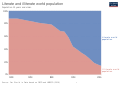 Literacy rate
 -
 Illiteracy in France
 -
 Bill of sale Louvre AO3765
 -
 Adult literacy rates have increased
 -
 Literacy has rapidly spread
 -
 Adult literacy rate, population 15+ years, male (%)
 -
 Adult literacy rate, population 15+ years, female (%)
 -
 Progress towards gender parity
 -
 Youth and adult literacy rate, 2000–2016 and projections to 2030
 -
 Students in grade 2 who can't read a single word ca 2015


,_OWID.svg)
,_OWID.svg)


