Ribosome biogenesis: Difference between revisions
CSV import |
CSV import Tags: mobile edit mobile web edit |
||
| Line 31: | Line 31: | ||
[[Category:Genetics]] | [[Category:Genetics]] | ||
{{medicine-stub}} | {{medicine-stub}} | ||
<gallery> | |||
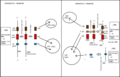
File:RRNA_genes_and_rRNA_biogenesis.png|RRNA genes and rRNA biogenesis | |||
</gallery> | |||
Latest revision as of 21:08, 23 February 2025
Ribosome biogenesis[edit]
Ribosome biogenesis is the complex process through which cells produce ribosomes, the cellular machinery responsible for protein synthesis. This intricate process involves the assembly of ribosomal RNA (rRNA) and ribosomal proteins into functional ribosomes. Ribosome biogenesis is essential for cell growth, proliferation, and overall cellular function.
Overview[edit]
Ribosome biogenesis occurs in the nucleolus, a specialized subcompartment of the cell nucleus. The process involves multiple steps, including transcription of rRNA genes, processing of pre-rRNA transcripts, modification of rRNA, assembly of ribosomal proteins, and final maturation of the ribosomal subunits.
Transcription of rRNA genes[edit]
The first step in ribosome biogenesis is the transcription of rRNA genes by RNA polymerase I. These genes encode the precursor rRNA (pre-rRNA) that will be processed and assembled into mature ribosomes.
Processing of pre-rRNA transcripts[edit]
After transcription, the pre-rRNA undergoes a series of processing steps to remove spacer sequences and generate the mature 18S, 5.8S, and 28S rRNAs. This processing is mediated by a complex machinery of small nucleolar RNAs (snoRNAs) and ribonucleoproteins.
Modification of rRNA[edit]
Once processed, the rRNA molecules undergo various modifications, such as methylation and pseudouridylation, to ensure proper folding and function of the ribosomal subunits.
Assembly of ribosomal proteins[edit]
Simultaneously, ribosomal proteins are synthesized in the cytoplasm and imported into the nucleus for assembly with the processed rRNA molecules. The coordinated binding of ribosomal proteins to rRNA forms the small and large ribosomal subunits.
Final maturation of ribosomal subunits[edit]
The small and large ribosomal subunits are exported from the nucleus to the cytoplasm, where they undergo final maturation steps before joining together to form functional ribosomes. These mature ribosomes are then ready to participate in protein synthesis.

-
 RRNA genes and rRNA biogenesis

