Skunk: Difference between revisions
CSV import |
CSV import |
||
| Line 24: | Line 24: | ||
{{stub}} | {{stub}} | ||
<gallery> | |||
File:Striped_Skunk.jpg|Striped Skunk | |||
File:Hooded_skunk_skeleton.JPG|Hooded Skunk Skeleton | |||
File:The_back_left_foot_of_an_albino_skunk.jpg|The Back Left Foot of an Albino Skunk | |||
File:Striped_Skunk_(Mephitis_mephitis)_01_(cropped).jpg|Striped Skunk (Mephitis mephitis) | |||
File:Female_skunk_with_young.webm|Female Skunk with Young | |||
File:Young_skunk.webm|Young Skunk | |||
File:Skunk_about_to_spray.jpg|Skunk About to Spray | |||
File:SkunkMuskChem.svg|Skunk Musk Chemical Structure | |||
File:Striped_skunk_Freddy.jpg|Striped Skunk Freddy | |||
File:Pet_Albino_Skunk_on_a_harness.jpg|Pet Albino Skunk on a Harness | |||
</gallery> | |||
Latest revision as of 21:08, 23 February 2025
Skunk is a common name for any of the various species of mammals in the family Mephitidae. Skunks are known for their ability to spray a liquid with a strong, unpleasant smell as a form of self-defense.
Description[edit]
Skunks are small to medium-sized mammals, usually with black and white fur. They have a distinctive bushy tail and a small head with short, rounded ears. The most recognizable feature of the skunk is the pair of large scent glands located near the base of the tail. These glands produce a mixture of sulfur-containing chemicals that the skunk can spray as a potent deterrent to predators.
Behavior[edit]
Skunks are typically nocturnal, solitary animals. They are omnivorous, feeding on a variety of foods including insects, small mammals, fruits, and plants. Skunks have few natural predators, due in large part to their potent defensive spray. When threatened, a skunk will arch its back, raise its tail, and hiss before spraying.
Species[edit]
There are several species of skunks, including the striped skunk (Mephitis mephitis), the spotted skunk (Spilogale putorius), and the hog-nosed skunk (Conepatus leuconotus). Each species has its own unique characteristics and behaviors.
Human interaction[edit]
Skunks are often considered pests due to their habit of digging up lawns and gardens in search of food. They are also carriers of diseases such as rabies. However, skunks also play a beneficial role in controlling insect and rodent populations.
See also[edit]
 | |
|---|---|
 |
 |
-
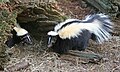 Striped Skunk
 -
 Hooded Skunk Skeleton
 -
 The Back Left Foot of an Albino Skunk
 -
 Striped Skunk (Mephitis mephitis)
 -
 Female Skunk with Young
 -
 Young Skunk
 -
 Skunk About to Spray
 -
 Skunk Musk Chemical Structure
 -
 Striped Skunk Freddy
 -
 Pet Albino Skunk on a Harness


_01_(cropped).jpg)


