Coral: Difference between revisions
CSV import |
CSV import |
||
| Line 28: | Line 28: | ||
{{stub}} | {{stub}} | ||
{{dictionary-stub1}} | {{dictionary-stub1}} | ||
<gallery> | |||
File:Coral_Outcrop_Flynn_Reef.jpg|Coral Outcrop Flynn Reef | |||
File:Coral_polyp.jpg|Coral polyp | |||
File:Montastrea_cavernosa.jpg|Montastrea cavernosa | |||
File:nematocyst_discharge.png|Nematocyst discharge | |||
File:Coral_Life_Cycles_ZP.svg|Coral Life Cycles ZP | |||
File:Brain_coral_spawning.jpg|Brain coral spawning | |||
File:Stony_coral_spawning_2.jpg|Stony coral spawning 2 | |||
File:Life_Cycle_of_Corals.svg|Life Cycle of Corals | |||
File:Orbicella_annularis_-_calices.jpg|Orbicella annularis - calices | |||
File:Coral_polyp.jpg|Coral polyp | |||
File:Bacterial_OTUs_from_clone_libraries_and_next-generation_sequencing.png|Bacterial OTUs from clone libraries and next-generation sequencing | |||
</gallery> | |||
Latest revision as of 21:04, 23 February 2025
Coral is a type of marine invertebrate from the class Anthozoa. They typically live in compact colonies of many identical individual polyps. The group includes the important reef builders that inhabit tropical oceans and secrete calcium carbonate to form a hard skeleton.
Biology[edit]
A coral "group" is a colony of myriad genetically identical polyps. Each polyp is a sac-like animal typically only a few millimeters in diameter and a few centimeters in length. A set of tentacles surround a central mouth opening. An exoskeleton is excreted near the base. Over many generations, the colony thus creates a large skeleton characteristic of the species. Individual heads grow by asexual reproduction of polyps.
Coral reefs[edit]
Coral reefs are underwater structures made from calcium carbonate secreted by corals. Coral reefs are colonies of tiny animals found in marine waters that contain few nutrients. Most coral reefs are built from stony corals, whose polyps cluster in groups.
Threats to coral[edit]
Coral reefs are dying around the world. In particular, coral mining, pollution (organic and non-organic), overfishing, blast fishing, disease, and the digging of canals and access into islands and bays are localized threats to coral ecosystems. Broader threats are sea temperature rise, sea level rise and pH changes from ocean acidification, all associated with greenhouse gas emissions.
See also[edit]
References[edit]
<references />
External links[edit]
 | |
|---|---|
 |
 |
-
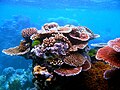 Coral Outcrop Flynn Reef
 -
 Coral polyp
 -
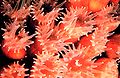 Montastrea cavernosa
 -
 Nematocyst discharge
 -
 Coral Life Cycles ZP
 -
 Brain coral spawning
 -
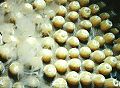 Stony coral spawning 2
 -
 Life Cycle of Corals
 -
 Orbicella annularis - calices
 -
Coral polyp
-
 Bacterial OTUs from clone libraries and next-generation sequencing


