Wind: Difference between revisions
CSV import Tags: mobile edit mobile web edit |
CSV import |
||
| Line 22: | Line 22: | ||
{{stub}} | {{stub}} | ||
== Wind == | |||
<gallery> | |||
File:Cherry_tree_moving_in_the_wind_1.gif|Cherry tree moving in the wind | |||
File:10_PM_March_12_surface_analysis_of_Great_Blizzard_of_1888.png|10 PM March 12 surface analysis of Great Blizzard of 1888 | |||
File:Anemometer_2745.JPG|Anemometer | |||
File:Occluded_mesocyclone_tornado5_-_NOAA.jpg|Occluded mesocyclone tornado | |||
File:Wind_barbs.gif|Wind barbs | |||
File:Map_prevailing_winds_on_earth.png|Map of prevailing winds on Earth | |||
File:Earth_Global_Circulation.jpg|Earth Global Circulation | |||
File:Franklingulfstream.jpg|Franklin Gulf Stream | |||
File:Map_local_winds.png|Map of local winds | |||
File:Diagrama_de_formacion_de_la_brisa-breeze.svg|Diagram of formation of the breeze | |||
File:Vol_d'onde.svg|Vol d'onde | |||
</gallery> | |||
Latest revision as of 21:02, 23 February 2025
Wind is the flow of gases on a large scale. On the surface of the Earth, wind consists of the bulk movement of air. In outer space, solar wind is the movement of gases or charged particles from the Sun through space, while planetary wind is the outgassing of light chemical elements from a planet's atmosphere into space. Winds are commonly classified by their spatial scale, their speed, the types of forces that cause them, the regions in which they occur, and their effect. The strongest observed winds on a planet in our solar system occur on Neptune and Saturn.
Causes of wind[edit]
Wind is caused by differences in the atmospheric pressure. When a difference in atmospheric pressure exists, air moves from the higher to the lower pressure area, resulting in winds of various speeds. On a rotating planet, air will also be deflected by the Coriolis effect, except exactly on the equator. Globally, the two major driving factors of large-scale wind patterns (the atmospheric circulation) are the differential heating between the equator and the poles (difference in absorption of solar energy leading to buoyancy forces) and the rotation of the planet.
Measurement[edit]
Wind speed is measured by anemometers, most commonly using cups or propellers. When a high measurement frequency is needed (such as in research applications), wind can be measured by the propagation speed of ultrasound signals or by the effect of ventilation on the resistance of a heated wire. Another type of anemometer uses pitot tubes that take advantage of the pressure differential between an inner tube and an outer tube that is exposed to the wind to determine the dynamic pressure, which is then used to compute the wind speed.
Effects[edit]
Wind has a range of effects on the environment and on human activity. It can erode land and change the shape of the landscape by moving soil and sediment. It can also affect the spread of wildfires and the distribution of pollutants. Wind can damage or destroy structures and can cause power outages. It can also have effects on transportation, making some forms of travel easier or more difficult.
See also[edit]
 | |
|---|---|
 |
 |
Wind[edit]
-
 Cherry tree moving in the wind
 -
 10 PM March 12 surface analysis of Great Blizzard of 1888
 -
 Anemometer
 -
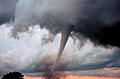 Occluded mesocyclone tornado
 -
 Wind barbs
 -
 Map of prevailing winds on Earth
 -
 Earth Global Circulation
 -
 Franklin Gulf Stream
 -
 Map of local winds
 -
 Diagram of formation of the breeze
 -
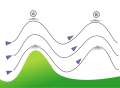 Vol d'onde


