Sustainable development: Difference between revisions
CSV import |
CSV import |
||
| Line 29: | Line 29: | ||
{{stub}} | {{stub}} | ||
{{dictionary-stub1}} | {{dictionary-stub1}} | ||
== Sustainable development == | |||
<gallery> | |||
File:Sustainable_development_-_6_central_capacities.png|Sustainable development - 6 central capacities | |||
File:Highlight_Findings_of_the_WA_S0E_2007_report.gif|Highlight Findings of the WA S0E 2007 report | |||
File:Sustainable_Development_Goals.png|Sustainable Development Goals | |||
File:A_RES_71_313_E.pdf|A RES 71 313 E | |||
</gallery> | |||
Latest revision as of 21:00, 23 February 2025
Sustainable Development is a developmental approach that aims to meet the needs of the present without compromising the ability of future generations to meet their own needs. It involves the balancing of economic growth, social inclusion, and environmental protection. These three pillars of sustainable development are interdependent and mutually reinforcing.
Definition[edit]
The most frequently quoted definition of sustainable development is from the Brundtland Report, officially titled Our Common Future, from the United Nations World Commission on Environment and Development (WCED) in 1987. It defines sustainable development as "development that meets the needs of the present without compromising the ability of future generations to meet their own needs."
Principles[edit]
Sustainable development is based on several principles, including:
- Intergenerational equity: The needs of future generations should be considered in today's decisions.
- Intragenerational equity: Resources should be distributed fairly among the current generation.
- Precautionary principle: If an action or policy has the potential to cause harm to the public or the environment, in the absence of scientific consensus, the burden of proof falls on those advocating for the action or policy.
- Polluter pays principle: Those who produce pollution should bear the costs of managing it.
Three Pillars[edit]
Sustainable development is often described as being built on three pillars:
- Economic sustainability: This involves using various strategies for employing existing resources optimally so that a responsible and beneficial balance can be achieved over the longer term.
- Environmental sustainability: This involves making decisions and taking actions that are in the interests of protecting the natural world, with particular emphasis on preserving the capability of the environment to support human life.
- Social sustainability: This involves managing human use of fellow human beings and human use of its self, in such a manner that it is regarded as being "sustainable" from a social perspective.
See Also[edit]
 | |
|---|---|
 |
 |
This article is a medical stub. You can help WikiMD by expanding it!
Sustainable development[edit]
-
 Sustainable development - 6 central capacities
 -
 Highlight Findings of the WA S0E 2007 report
 -
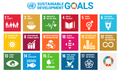 Sustainable Development Goals
 -
 A RES 71 313 E


