Black gill disease: Difference between revisions
CSV import |
CSV import |
||
| Line 24: | Line 24: | ||
{{disease-stub}} | {{disease-stub}} | ||
{{dictionary-stub1}} | {{dictionary-stub1}} | ||
<gallery caption="Black_gill_disease"> | |||
File:Ciliate_collage.jpg|Ciliate collage | |||
File:Fish_Respiration_Through_Gills.svg|Fish Respiration Through Gills | |||
</gallery> | |||
Revision as of 20:58, 23 February 2025
Black gill disease is a disease of crustaceans.
Occurrence
It has been observed in spiny lobsters (Panulirus ornatus) in Vietnam,<ref name="nha">V. V. H. Nha, D.T. and L.V. Khoa (2009). "Black gill disease of cage-cultured ornate rock lobster Panulirus ornatus in central Vietnam caused by Fusarium species." Aquatic animal health 15(4): 35-37.</ref> where it is caused by a species of Fusarium.<ref name="nha" />
It has been observed in shrimp, where the agent is microscopic protozoan Hyalophysa chattoni or a close relative, in Galveston Bay, Texas and other locations.<ref>{{{last}}},
 Jerald Horst,

 Black Gill Disease in Shrimp. online version,

 Louisiana State University,


 Volume: 3,</ref>
Causes
There are multiple sources known to cause black gill disease. Poor pond conditions can cause debris to build up in the gills turning them black. Certain kinds of bacteria and the fungus genus Fusarium are also known causes. (January 2019)
Prevention
With extra care taken to the health of the shrimp, it is possible to prevent cases of black gill disease. The water should have 10-20 parts per thousand parts salinity and filtered.<ref>
Manuel on Pond Culture of Penaeid Shrimp(link). FAO Corporate Document Repository. Association of Southeast Asian Nations. 1978.
</ref>
References
<references group="" responsive="1"></references>


- Black_gill_disease
-
 Ciliate collage
 -
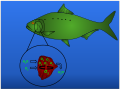 Fish Respiration Through Gills


