Pita: Difference between revisions
CSV import |
CSV import |
||
| Line 1: | Line 1: | ||
{{ | {{short description|Type of flatbread}} | ||
{{Use dmy dates|date=October 2023}} | |||
'''Pita''' is a type of [[flatbread]] that is commonly consumed in the [[ | ==Pita== | ||
[[File:Pita_From_Greece.jpg|thumb|right|Traditional Greek pita bread]] | |||
'''Pita''' is a type of [[flatbread]] that is commonly consumed in the [[Middle East]], [[Mediterranean]], and surrounding regions. It is known for its characteristic pocket, which forms during the baking process, allowing it to be filled with various ingredients. | |||
==History== | ==History== | ||
The origins of pita can be traced back to ancient times, with evidence suggesting that it was consumed by the peoples of the [[Levant]] and [[Mesopotamia]]. Over the centuries, pita has become a staple in many cultures, each adding their own unique twist to the bread. | |||
==Preparation== | ==Preparation== | ||
Pita is | Pita is typically made from a simple dough consisting of [[flour]], [[water]], [[yeast]], and [[salt]]. The dough is kneaded and left to rise before being divided into small balls. These are then rolled out into flat discs and baked at high temperatures, causing the dough to puff up and form a pocket. | ||
[[File: | ==Culinary Uses== | ||
[[File:PikiWiki_Israel_30304_Events_in_Israel.jpg|thumb|left|Pita bread served with various dips]] | |||
Pita is versatile and can be used in a variety of dishes. It is often served with [[hummus]], [[baba ghanoush]], or [[tzatziki]]. The pocket can be filled with ingredients such as [[falafel]], [[shawarma]], or [[kebab]]. | |||
== | ===Regional Variations=== | ||
Pita | [[File:ראנץ'_בפיתה.jpg|thumb|right|Pita filled with falafel]] | ||
In the [[Middle East]], pita is a staple food and is often used to scoop up food or as a wrap. In [[Greece]], it is commonly used for [[gyros]]. In [[Turkey]], a similar bread known as [[pide]] is popular. | |||
==Cultural Significance== | |||
Pita holds cultural significance in many regions. It is often associated with hospitality and is a common feature in [[Middle Eastern cuisine]]. | |||
== | ==Related Foods== | ||
Pita | [[File:Lunch_at_the_beach_North_of_Jaffa_(4158698648).jpg|thumb|left|Pita served with a variety of dishes]] | ||
Pita is related to other flatbreads such as [[naan]], [[lavash]], and [[tortilla]]. Each of these breads has its own unique characteristics and cultural significance. | |||
== | ==Gallery== | ||
<gallery> | |||
File:Pide_and_ayran.jpg|Turkish pide served with ayran | |||
File:Palestinianbreakfastfalafel.jpg|Palestinian breakfast with falafel and pita | |||
File:Tırnaklı_pide_1.jpg|Tırnaklı pide, a variation of Turkish pide | |||
File:Jerusalem_shawarma.jpg|Shawarma served in pita | |||
</gallery> | |||
==Related pages== | ==Related pages== | ||
* [[Flatbread]] | * [[Flatbread]] | ||
* [[ | * [[Middle Eastern cuisine]] | ||
* [[Mediterranean cuisine]] | * [[Mediterranean cuisine]] | ||
[[Category:Flatbreads]] | [[Category:Flatbreads]] | ||
[[Category:Middle Eastern cuisine]] | |||
[[Category:Mediterranean cuisine]] | [[Category:Mediterranean cuisine]] | ||
Latest revision as of 14:17, 21 February 2025
Type of flatbread
Pita[edit]

Pita is a type of flatbread that is commonly consumed in the Middle East, Mediterranean, and surrounding regions. It is known for its characteristic pocket, which forms during the baking process, allowing it to be filled with various ingredients.
History[edit]
The origins of pita can be traced back to ancient times, with evidence suggesting that it was consumed by the peoples of the Levant and Mesopotamia. Over the centuries, pita has become a staple in many cultures, each adding their own unique twist to the bread.
Preparation[edit]
Pita is typically made from a simple dough consisting of flour, water, yeast, and salt. The dough is kneaded and left to rise before being divided into small balls. These are then rolled out into flat discs and baked at high temperatures, causing the dough to puff up and form a pocket.
Culinary Uses[edit]

Pita is versatile and can be used in a variety of dishes. It is often served with hummus, baba ghanoush, or tzatziki. The pocket can be filled with ingredients such as falafel, shawarma, or kebab.
Regional Variations[edit]

In the Middle East, pita is a staple food and is often used to scoop up food or as a wrap. In Greece, it is commonly used for gyros. In Turkey, a similar bread known as pide is popular.
Cultural Significance[edit]
Pita holds cultural significance in many regions. It is often associated with hospitality and is a common feature in Middle Eastern cuisine.
Related Foods[edit]
.jpg)
Pita is related to other flatbreads such as naan, lavash, and tortilla. Each of these breads has its own unique characteristics and cultural significance.
Gallery[edit]
-
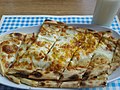 Turkish pide served with ayran
 -
 Palestinian breakfast with falafel and pita
 -
 Tırnaklı pide, a variation of Turkish pide
 -
 Shawarma served in pita


