Salt evaporation pond: Difference between revisions
CSV import Tags: mobile edit mobile web edit |
CSV import |
||
| Line 35: | Line 35: | ||
* [[External Link 3]] | * [[External Link 3]] | ||
{{dictionary-stub1}} | {{dictionary-stub1}} | ||
<gallery> | |||
File:Salt_evaporation_pond_in_Manaure.jpg|Salt evaporation pond in Manaure | |||
File:Least_work_evaporating_water_into_air.png|Least work evaporating water into air | |||
File:Salt_ponds_SF_Bay_(dro!d).jpg|Salt ponds SF Bay | |||
File:2014_Cape_Verde._Sal._Saltkratern_(2).JPEG|Salt evaporation pond | |||
File:Marakkanam_Salt_Pans.JPG|Marakkanam Salt Pans | |||
File:Lithium_mine,_Salar_del_Hombre_Muerto,_Argentina.jpg|Lithium mine, Salar del Hombre Muerto, Argentina | |||
File:Lanzarote_salt_pans.jpg|Lanzarote salt pans | |||
File:Solar_Evaporation_Ponds,_Atacama_Desert.jpg|Solar Evaporation Ponds, Atacama Desert | |||
File:Fundacion_Valle_Salado511.JPG|Fundacion Valle Salado | |||
File:Vallesaladoanana.jpg|Vallesaladoanana | |||
</gallery> | |||
Latest revision as of 21:46, 20 February 2025
Introduction[edit]
A Salt evaporation pond is a man-made body of water specifically designed for the production of salt. This is achieved through the process of evaporation, which involves exposing the water to the sun and wind until it evaporates, leaving behind the salt.
Process[edit]
The process of creating a salt evaporation pond involves several steps. First, a shallow pond is created near a sea or saltwater lake. The pond is then filled with saltwater, either by natural means such as tidal flow, or by manual means such as pumping. The water is left to evaporate under the sun and wind, a process that can take several weeks or even months. As the water evaporates, the salt concentration increases. When the concentration reaches saturation point, the salt begins to crystallize and precipitate out of the water. The salt is then harvested, usually by hand, and processed for use.
Uses[edit]
Salt evaporation ponds are used primarily for the production of salt, which has a wide range of uses. These include food seasoning, preservation, and industrial applications such as the production of chlorine and caustic soda. In addition, the ponds can also serve as a habitat for various species of birds and other wildlife, particularly in areas where natural wetlands have been lost.
Environmental Impact[edit]
While salt evaporation ponds can provide important habitat for wildlife, they can also have negative environmental impacts. These include the alteration of natural landscapes and ecosystems, the potential for water pollution due to the high salt concentration, and the use of large amounts of water. However, with careful management and planning, these impacts can be minimized.
See Also[edit]
References[edit]
External Links[edit]

-
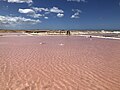 Salt evaporation pond in Manaure
 -
 Least work evaporating water into air
 -
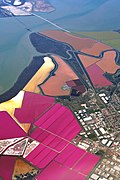 Salt ponds SF Bay
 -
 Salt evaporation pond
 -
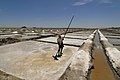 Marakkanam Salt Pans
 -
 Lithium mine, Salar del Hombre Muerto, Argentina
 -
 Lanzarote salt pans
 -
 Solar Evaporation Ponds, Atacama Desert
 -
 Fundacion Valle Salado
 -
 Vallesaladoanana


.jpg)
.JPEG)


