Rosette de Lyon: Difference between revisions
CSV import |
CSV import |
||
| Line 36: | Line 36: | ||
* [http://www.lyon-tourism.com Lyon Tourism] | * [http://www.lyon-tourism.com Lyon Tourism] | ||
{{dictionary-stub1}} | {{dictionary-stub1}} | ||
<gallery> | |||
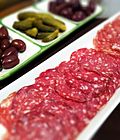
File:Rosette_de_Lyon.jpg|Rosette de Lyon | |||
</gallery> | |||
Latest revision as of 21:46, 20 February 2025
Rosette de Lyon[edit]
The Rosette de Lyon is a traditional French sausage originating from the city of Lyon. It is a dry-cured sausage, typically made from pork, and is a staple of Lyonnaise cuisine.
History[edit]
The Rosette de Lyon has a rich history dating back to the Roman times. It was during this period that the technique of dry-curing meats was first introduced to the region. The sausage gets its name from the traditional practice of hanging the sausages in a rosette shape to dry.
Production[edit]
The production of the Rosette de Lyon involves a careful process of selecting the finest cuts of pork, seasoning them with a blend of spices, and then allowing the sausage to dry-cure over a period of several months. The result is a sausage with a distinctive flavor and texture.
Culinary Uses[edit]
The Rosette de Lyon is often served as part of a charcuterie board, alongside other cured meats, cheeses, and pickles. It can also be used in a variety of dishes, such as salads, sandwiches, and pasta.
Pairings[edit]
The rich, savory flavor of the Rosette de Lyon pairs well with a variety of wines, particularly those from the Rhone Valley. It also complements a range of cheeses, particularly those with a strong flavor, such as Roquefort or Camembert.
See Also[edit]
References[edit]
- The Art of Charcuterie, by John Kowalski and the Culinary Institute of America
- The Oxford Companion to Food, by Alan Davidson
External Links[edit]

-
 Rosette de Lyon

