Moroccan citron: Difference between revisions
CSV import Tags: mobile edit mobile web edit |
CSV import |
||
| Line 24: | Line 24: | ||
{{Citrus-stub}} | {{Citrus-stub}} | ||
{{food-stub}} | {{food-stub}} | ||
<gallery> | |||
File:MoroccoEtrog.JPG|Morocco Etrog | |||
File:Berbers_citron.jpg|Berbers citron | |||
File:Climbing_up.jpg|Climbing up | |||
File:Halved_seedless_Moroccan_citron.jpg|Halved seedless Moroccan citron | |||
File:MoroccanWSeeds.jpg|Moroccan with seeds | |||
</gallery> | |||
Latest revision as of 21:39, 20 February 2025
Moroccan Citron is a variety of citron, a large fragrant citrus fruit with a thick rind, native to Morocco. It is also known as Etrog in Hebrew and is used in the Jewish festival of Sukkot.
History[edit]
The Moroccan Citron has been cultivated in Morocco for centuries and is considered one of the oldest citrus fruits in the country. It is believed to have been introduced to Morocco by Jewish settlers who migrated from the Middle East.
Cultivation[edit]
The Moroccan Citron is grown primarily in the regions of Chefchaouen and Fez. The fruit is typically harvested in the late summer and early fall. The Moroccan Citron tree is evergreen and can reach a height of up to 15 feet. The fruit is oval to oblong in shape and has a thick, yellow rind when ripe.
Uses[edit]
In addition to its use in the Sukkot festival, the Moroccan Citron is also used in Moroccan cuisine. It is often preserved in salt and used to flavor dishes such as tagine and couscous. The rind can also be candied and used in desserts.
Cultural Significance[edit]
The Moroccan Citron holds a significant place in Moroccan culture and Jewish religious practices. During Sukkot, the fruit is used as one of the Four Species that are waved in a special ceremony. The fruit is also a symbol of fertility and abundance in Moroccan folklore.
See Also[edit]


-
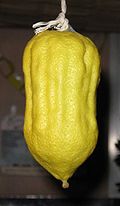 Morocco Etrog
 -
 Berbers citron
 -
 Climbing up
 -
 Halved seedless Moroccan citron
 -
 Moroccan with seeds


