Matzah brei: Difference between revisions
CSV import Tags: mobile edit mobile web edit |
CSV import |
||
| Line 24: | Line 24: | ||
{{Jewish-stub}} | {{Jewish-stub}} | ||
{{food-stub}} | {{food-stub}} | ||
<gallery> | |||
File:Matzah_brei_serving.jpg|Matzah brei serving | |||
File:מצה_ברייט_בהכנה.JPG|Matzah brei preparation | |||
File:Matzah_breit.JPG|Matzah brei | |||
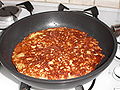
File:Maza_gebrent_pan.jpg|Matzah brei in pan | |||
</gallery> | |||
Latest revision as of 21:39, 20 February 2025
Matzah brei (also spelled Matzo brei) is a traditional Ashkenazi Jewish dish typically eaten during the Passover holiday. The dish is made from soaked pieces of matzah and eggs.
History[edit]
The origins of Matzah brei are rooted in the Ashkenazi Jewish communities of Eastern Europe. The dish is traditionally consumed during Passover, a Jewish holiday commemorating the liberation of the Israelites from Egyptian slavery. During Passover, the consumption of leavened bread is forbidden, making matzah, an unleavened bread, a staple food.
Preparation[edit]
The preparation of Matzah brei involves soaking pieces of matzah in water or milk until they become soft. The softened matzah is then mixed with beaten eggs and fried in a pan. The dish can be made either sweet or savory, depending on the ingredients added. Sweet versions often include ingredients such as sugar, cinnamon, and apples, while savory versions may include onions, pepper, and salt.
Variations[edit]
There are numerous variations of Matzah brei around the world. In some regions, the dish is made with matzah meal instead of whole pieces of matzah. Other variations may include additional ingredients such as cheese, vegetables, or meat.
Cultural Significance[edit]
Matzah brei holds a significant place in Jewish cuisine, particularly during the Passover holiday. The dish is often associated with comfort and tradition, and is a common feature in Passover meals.
See Also[edit]


-
Matzah brei serving
-
Matzah brei preparation
-
 Matzah brei
 -
 Matzah brei in pan


